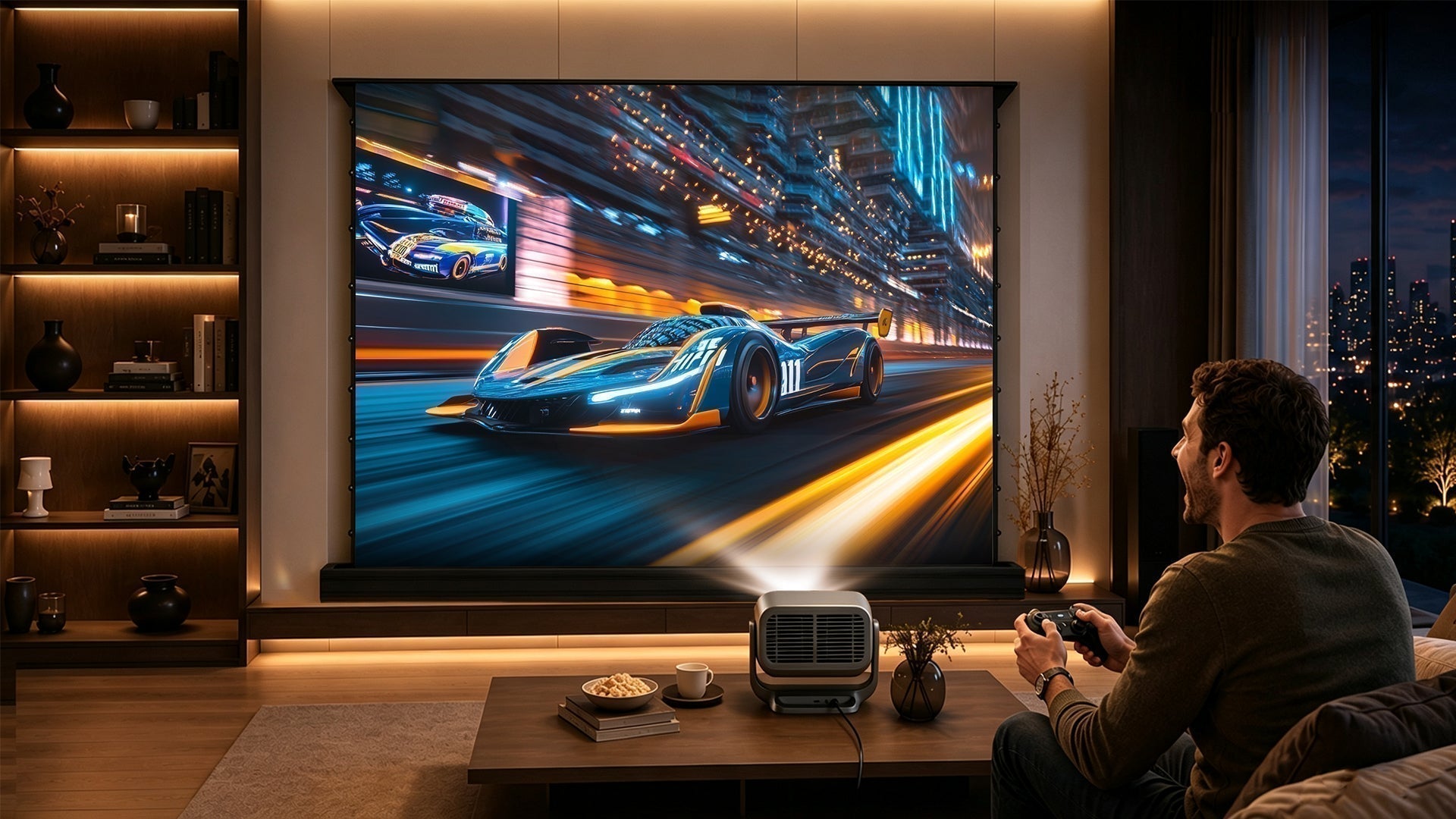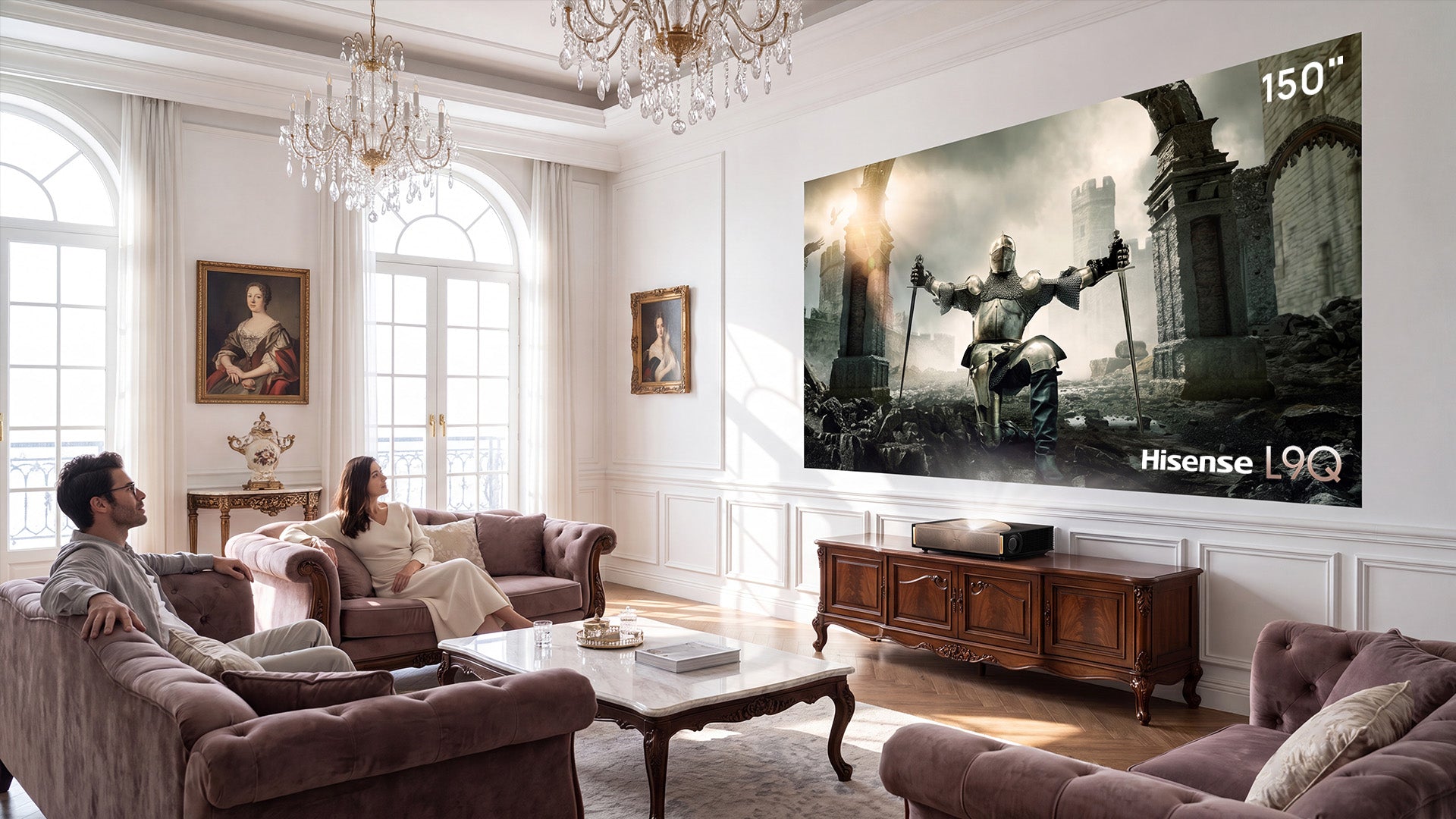




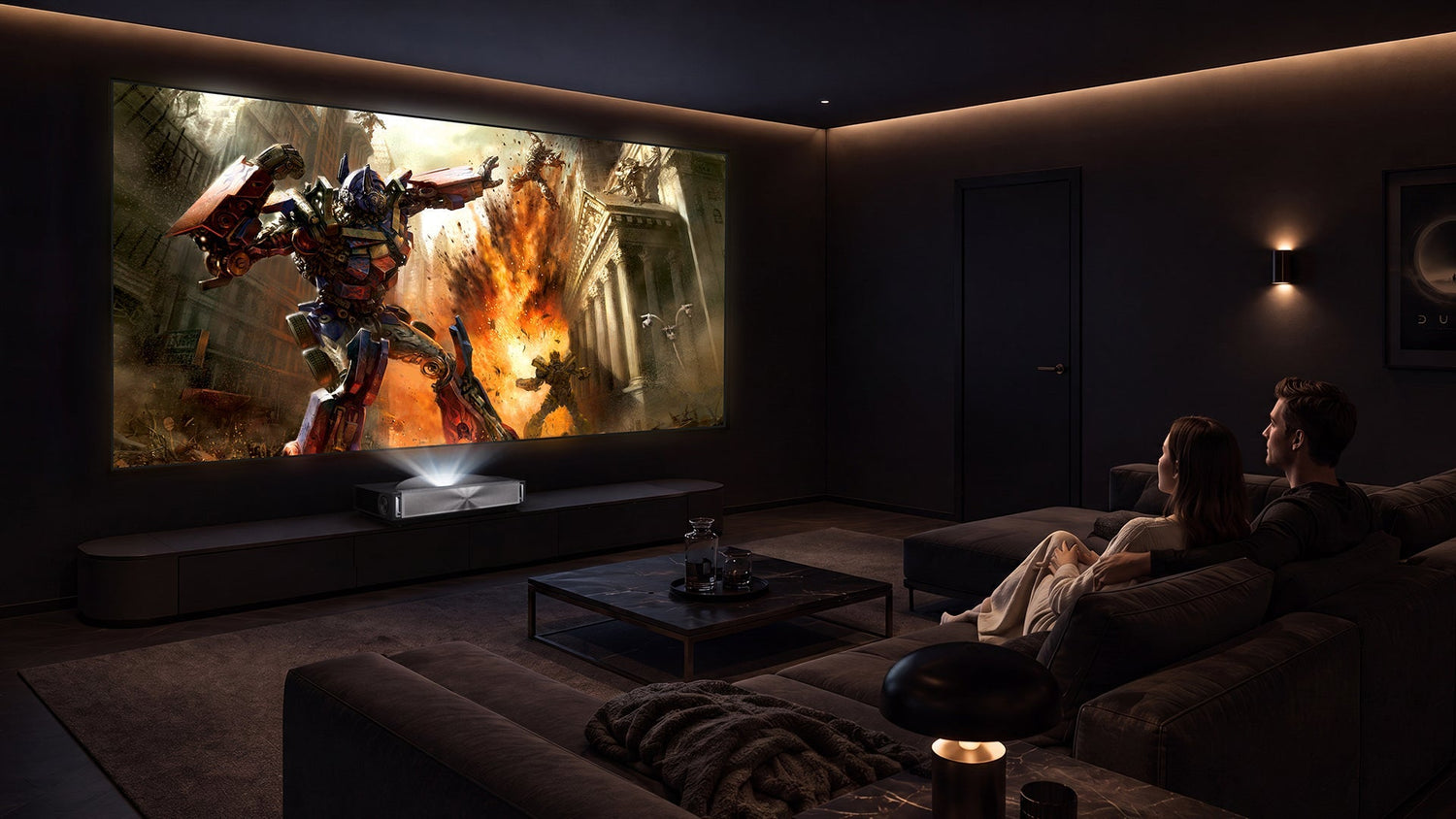
Walk into any projector forum or browse through Amazon reviews, and you’ll see the same obsession repeated ad nauseam: lumens. How bright is it? Can I watch it with the lights on? Will it wash out in daylight?
These are fair questions—but they’ve created a generation of buyers who treat ANSI lumens like the single metric that matters. And that’s precisely where the trouble begins.
The reality? A projector with sky-high brightness numbers can still deliver a thoroughly disappointing image. Users routinely report that high-lumen projectors produce washed-out blacks, oversaturated colors that look unnatural, and HDR content that falls flat because the tone mapping can’t keep up. One common complaint across tri-color laser UST owners: “It’s bright, but the colors look off, and dark scenes are a mess.”
Why? Because brightness without intelligent processing is just raw light. It’s like having a sports car with a massive engine but no steering system—powerful, but going nowhere good. The truth is, tri-color laser technology brings extraordinary color potential—110% of BT.2020 color space is now achievable. But that potential means nothing if the projector can’t intelligently manage contrast, tone mapping, motion, and real-time scene adaptation. The chip—not the lumen count—is what separates a great projector from a mediocre one. That’s where the Hisense PX4-Pro enters the conversation, and where the conversation shifts from “how bright” to “how smart.”
Part 1: The Chip & Algorithm “Computational Power” Advantage
Most consumers shopping for a tri-color laser UST projector look at the spec sheet and see brightness, contrast ratio, and throw distance. What they don’t see—but what matters enormously—is the processing engine driving the whole experience. Let’s look at how the PX4-Pro stacks up against its key competitors:
| Projector Model | Brightness | Contrast Ratio | Processing Platform | Key Differentiator |
|---|---|---|---|---|
| Hisense PX4-Pro | 3,500 ANSI Lumens | 6,000:1 Native (IRIS-enhanced) | Hisense AI Chipset + LPU 3.0 | Proprietary AI chip with real-time frame analysis |
| AWOL Vision Aetherion Max | 3,300 ISO Lumens | 6,000:1 Native | MediaTek MT9655 (Pentonic 800) | Off-the-shelf SoC architecture |
| AWOL Vision Aetherion Pro | 2,600 ISO Lumens | 6,000:1 Native | MediaTek MT9655 | Standardized platform, lower lumens |
| NexiGo Aurora Pro MKII | 2,400 ANSI Lumens | 4,000:1 Native | ALPD 5.0 Platform | Software-driven Scene Adapt Engine (SAE) |
| XGIMI Aura 2 | 2,300 ISO Lumens | 1,000,000:1 Dynamic | 0.47” DMD DLP Chip | Dual Light 2.0 Hybrid Light Source |

What jumps off this table isn’t the brightness numbers—it’s the processing story. Hisense drives the PX4-Pro with its newly upgraded LPU 3.0 Digital Laser Engine paired with advanced proprietary AI picture algorithms, not an off-the-shelf MediaTek or generic DLP processor. The AWOL Aetherion series, impressive as it is, relies on a capably standardized SoC that any TV manufacturer can license. Hisense, by contrast, has invested years and billions of R&D dollars into self-developed AI picture chips (the Xinxin AI Picture Chip family). This isn’t a licensing play—it’s a fundamental architectural advantage that provides complete technological self-reliance.
Part 2: The Technical Deep Dive—Why Hisense’s AI Chip Is a Generation Ahead
The Problem: Generic Processing Can’t Keep Up
Most UST projectors use off-the-shelf MediaTek or generic DLP processors. These chips are designed to be a jack-of-all-trades—they handle the smart OS system interface, decode video streams, and apply basic image filtering. But they lack the dedicated neural processing units (NPUs) and specialized hardware accelerators needed for real-time, scene-by-scene optimization. When a film shifts from a bright outdoor environment to a dark cave interior, a generic processor applies an inflexible, one-size-fits-all tone mapping curve. Highlights get crushed, shadow details vanish, and the dynamic image looks completely flat.
Hisense’s Solution: LPU 3.0 & Advanced Scene Adaptation
The PX4-Pro is powered by Hisense’s LPU 3.0 Digital Laser Engine paired with a fully upgraded AI-enabled chipset. Here’s what that actually means in technical terms:
- Real-Time Scene Analysis: Unlike static or manual aperture configurations, the PX4-Pro’s AI analyzes the incoming video signal in real time and automatically adjusts the mechanical IRIS lens aperture in fractions of a second. The aperture opens and closes dynamically with lightning speed, optimizing native contrast frame by frame.
- AI-Powered Upscaling: The system features an AI 4K Upscaler and an AI HDR Upscaler that automatically reconstruct low-resolution content into crisp ultra-high-definition clarity. This isn’t primitive pixel-doubling; it’s a deep learning-based reconstruction that draws on structural neural network advancements.
- End-to-End Color Optimization: Hisense’s proprietary algorithms optimize brightness, contrast ratios, and noise calibration simultaneously, delivering full-chain calibration across luminance, saturation, and color volume to reach absolute reference-level performance.
-
The Generational Gap: The off-the-shelf MediaTek MT9655 in the AWOL Aetherion, while capable, is a general-purpose TV SoC—it handles smart TV functions and basic video processing. Hisense’s chipset, by contrast, is purpose-built for laser projection, with dedicated AI accelerators and specialized algorithms tuned specifically for tri-color laser light sources.The gap isn’t incremental—it’s generational. We’re talking about the difference between a chip designed for “good enough” and a chip engineered for “reference-grade” performance.
The Patent & Innovation Story
This isn’t just marketing hype. Hisense holds hundreds of patents in display technology and has been developing its own AI picture chips for years. The company’s Xinxin AI Picture Chip(信芯)family represents China’s first fully self-developed 8K AI picture chips, with deep learning capabilities that adjust picture quality based on human visual perception. ThePX4-Pro builds on this legacy, bringing the same class of AI processing to the UST projector category.This is what it means to be “China’s No. 1, World’s No. 2” in display technology. Not just volume—vertical integration and technologicalself-reliance.
Part 3: Chip Comparison Matrix—Real-World Performance
| Processing Task | Hisense PX4-Pro (Proprietary AI Chip) | Competitors (Off-the-Shelf SoC) |
|---|---|---|
| HDR Tone Mapping | Real-time, scene-by-scene dynamic mapping | Static or pre-set fixed curves |
| Contrast Optimization | AI-driven active IRIS aperture lens adjustment | Fixed or manual aperture configurations |
| Motion Handling | Native 4K/120Hz processing + high-end MEMC | Typical 4K/60Hz limit with basic frame interpolation |
| Low-Resolution Upscaling | AI deep-learning structural reconstruction | Traditional bilinear pixel interpolation |
| Input Lag & Gaming Responsiveness | Ultra-low input lag below 20ms (4K/120Hz) | Highly variable; typically floats between 20-40ms |
Part 4: Real-World Scenarios—What the AI Chip Actually Fixes
Scenario 1: The Film Enthusiast’s Nightmare
- Speckle (laser noise): That grainy, “oily” shimmer on the screen, especially noticeable in bright, uniform areas. Research shows that speckle contrast above 4.1% causes visual discomfort, yet many tri-color laser projectors measure above 5%.
- Color fringing: Red and blue edges along high-contrast lines—what one industry source describes as “serious color fringing” that’s technically impossible to completely eliminate from tri-color laser systems.
- Crushed blacks: Dark scenes turn into muddy gray blobs because the processor can’t handle the dynamic range.

Scenario 2: The Gamer’s Dilemma
- Input lag: Even “low latency” modes often hover around 20-30ms—noticeable in competitive gaming.
- Screen tearing: Without VRR support, fast motion creates distracting visual artifacts.
- Motion blur: Generic MEMC (motion estimation/motion compensation) introduces a soap-opera effect or blur.
Part 5: Unlocking the Full Potential—The ALR Screen & Cabinet Solution
The NothingProjector Black Series 95% ALR Motorized Floor Rising Screen
- PET Crystal ALR material: Specially formulated for ultra-short-throw projection, rejecting ambient light while maintaining wide viewing angles
- Motorized floor-rising mechanism: Deploys and retracts with the touch of a button—no manual setup, no wall mounting
- Clean aesthetic: When retracted, it disappears into a low-profile floor-standing unit—no unsightly fixed frame on your wall
- Compatibility: Designed to work seamlessly with the PX4-Pro’s throw ratio and optical characteristics

The Value Proposition: NothingProjector vs. Lumene
The Complete Package: The USTProjector Cabinet
- Conceal the projector when not in use—keeping your living space clean and uncluttered
- Motorized deployment: With a single command, the cabinet opens, and the projector rises to the perfect projection height
- Precise alignment: Built-in micro-adjustment ensures the projector is perfectly positioned every time
- Aesthetic integration: Available in multiple finishes (black, walnut matte, wood grain) to match your décor
- Press a button
- The screen rises from the floor
- The cabinet opens, and the projector deploys
- Your 150-inch home theater comes to life