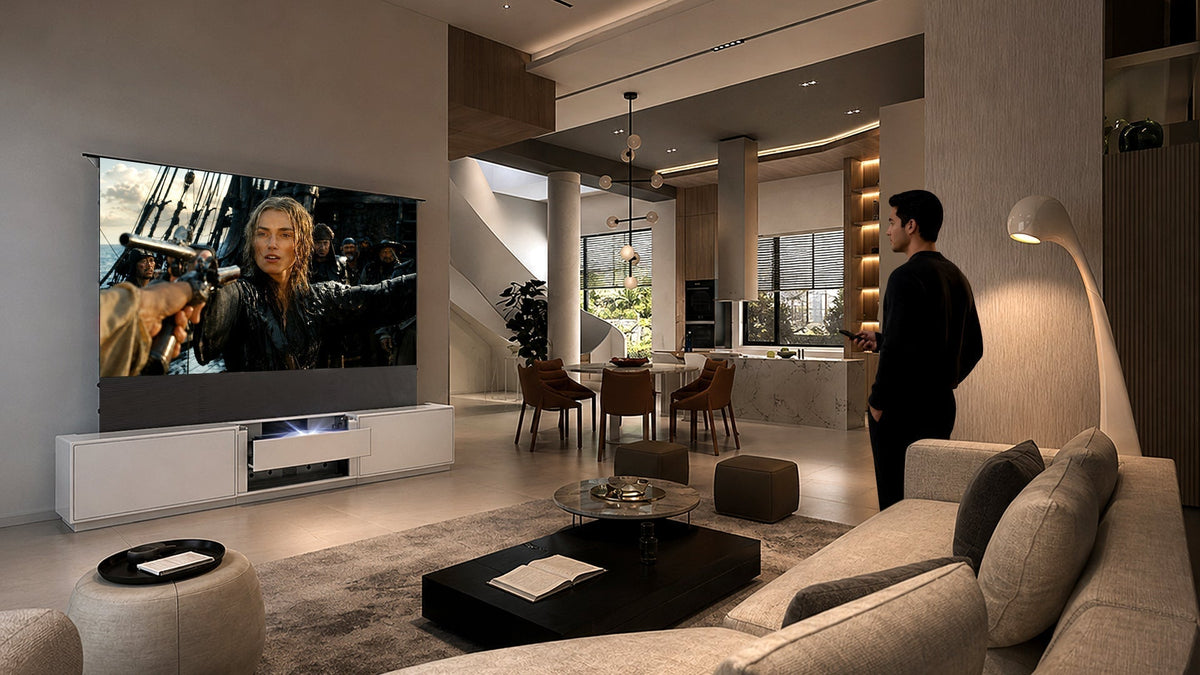




When it comes to creating the ultimate home theater or delivering a professional presentation, choosing the right projector is crucial. Projectors come in various types, each utilizing different technologies to produce images. Understanding these technologies and their advantages and disadvantages can help you make an informed decision. The imaging engine inside the box ultimately shapes the picture you see, and the screen you pair it with determines how much of that picture actually reaches your eyes.
LCD (Liquid Crystal Display) Projectors
LCD is a display technology that uses liquid crystals as optical elements. In an LCD projector, the light source passes through color filters and then enters the liquid crystal panel. The liquid crystal panel controls the amount of light passing through, which is then projected through a lens to form an image. LCD projectors are known for excellent color accuracy and sharp images, are generally more affordable than other types, and are typically reliable with low maintenance requirements. The traditional trade-offs are a lower contrast ratio—blacks can appear more like dark grays—and the possibility of a “screen door effect,” where the grid lines of the LCD panel become visible at low resolutions.
A current example that shows how far LCD projection has come is the Xming Episode Two. It is a compact LCD projector using an LED light source rated at 300 ISO lumens, paired with a native Full HD 1080p panel and a 1,500:1 contrast ratio. What makes the Episode Two notable is not just the core hardware but the way it packages that hardware for real-world use: Google TV with licensed Netflix, automatic focus and keystone correction, MEMC motion smoothing for fast-action content, and a body that weighs just 1.2 kg. For gaming, it keeps input lag down to 10 ms over HDMI 2.1 with ALLM auto game mode. The trade-off remains brightness—300 ISO lumens is best suited to controlled lighting rather than a sunlit living room. But for a bedroom, a shaded den, or a portable movie night, the Episode Two demonstrates that LCD projection can deliver a clean, colorful, smart experience without a premium price tag.


Formovie Xming Episode Two Google TV Projector
DLP (Digital Light Processing) Projectors
DLP is a display technology that uses digital micromirrors as optical elements. In a DLP projector, the light source passes through a spinning color wheel or a phosphor wheel, dividing the light into the primary colors. The digital micromirrors then control the projection of these colors, which are subsequently projected through a lens to form an image. DLP projectors are valued for high contrast ratios that produce deeper blacks, smooth motion handling that suits video playback, and a generally compact and lightweight design. The most commonly cited drawback is the “rainbow effect,” where some viewers perceive brief flashes of color, though this has become less pronounced on modern DLP chips with faster color wheels or RGB laser light sources.
The Xiaomi Laser Projector 3 illustrates where DLP technology sits at the higher end of the consumer market. It uses a 0.47-inch DMD chip—the DLP imaging core—to deliver true 4K resolution, while a pure tri-color laser light source pushes out 1,000 CVIA lumens and covers 110% of the BT.2020 color gamut. A 1,600:1 contrast ratio, MEMC processing, SGS low blue light certification, and dual 8W speakers with Dolby Audio round out the experience. An integrated gimbal allows 130° of angle adjustment, making placement far more forgiving than a fixed-lens design. This is still a DLP projector at its heart, so the familiar strengths—crisp detail, solid contrast, and a relatively compact footprint—are all present. What the Xiaomi adds is the polish of a modern smart projector: 4K clarity, laser-driven color volume, and audio that does not immediately demand a separate soundbar.


LED (Light Emitting Diode) Projectors
LED projectors use LED lights to produce the image. These LEDs can be red, green, and blue, which are combined to create the full spectrum of colors needed for the projected image. The light from the LEDs passes through the projection technology—either LCD panels or a DLP chip—to create the image, which is then projected onto the screen. LEDs have a long lifespan, often up to 20,000 hours, are energy-efficient and produce less heat, and maintain consistent color performance over time. The main limitations are brightness—LED projectors are generally not as bright as their lamp-based counterparts—and upfront cost, which can be higher than entry-level lamp models. LED is best understood as a light-source choice rather than a competing imaging technology; it can sit behind an LCD panel or a DLP chip and inherits the strengths and weaknesses of that imaging engine.
LCoS (Liquid Crystal on Silicon) Projectors
LCoS is a reflective variant of LCD technology. Instead of passing light through a transmissive liquid crystal panel, LCoS reflects light off a liquid-crystal-coated silicon backplane. This design can deliver very smooth, film-like images with minimal visible pixel structure, because the pixel gaps are less apparent than on conventional LCD panels. LCoS is most commonly found in higher-priced home theater projectors and some professional cinema installations. The trade-offs are cost and complexity: LCoS models tend to be more expensive than mainstream LCD or DLP options, and they are not typically the first choice for portable or budget-focused setups.
Laser Projectors
Laser projectors are defined by their light source rather than a single imaging method. A laser light source can be paired with DLP, LCD, or LCoS imaging, and it is valued for extreme brightness, exceptional color volume, long lifespan, and minimal maintenance. Laser projectors are suitable for large screens and well-lit environments, and they often deliver the most consistent color and contrast performance over many years of use. The drawbacks are cost and installation complexity: laser models are typically the most expensive category, and some installations may require professional setup. The Xiaomi Laser Projector 3 is a useful reference point here because it combines a laser light source with DLP imaging, showing that laser technology is no longer confined to high-end installation projectors—it has reached the consumer smart-projector market.
Which Projector Type Should You Choose?
After discussing so many types of projectors, you might feel a bit overwhelmed and unsure about which one to choose. For those with a sufficient budget and a focus on picture quality, a laser projector is a strong recommendation: laser projectors have higher contrast, richer colors, and provide a more stunning visual experience, making them particularly suitable for home theaters and high-end audio-visual needs. In an office or educational environment, an LED projector is an excellent choice, with a long lifespan, low power consumption, and superior color performance. If you have a limited budget but still want a large, colorful image for casual viewing, a well-implemented LCD projector like the Xming Episode Two can deliver far more than its price suggests, provided you match it to a light-controlled room.
Why the Screen Matters as Much as the Projector
A projector is only half of the optical equation. The screen is the surface that actually reflects the image back to your eyes, and its characteristics—gain, texture, and how it handles light—can make or break the final picture.
Screen gain is a measure of how much light the surface reflects compared with a standard matte-white reference. A gain of 1.3 reflects roughly 30% more light on-axis than a standard white screen of the same size. That extra reflectance can make a modest projector look punchier, or help a brighter model hold up in a room that is not fully blacked out. A matte-white surface also avoids the color shift and narrow viewing cones that some high-gain or grey screens introduce, keeping colors neutral and off-axis viewing comfortable. The other principle at work is diffuse reflection: a good matte-white screen spreads light evenly across the viewing area instead of creating a harsh hot spot in the center, which reduces eye strain during long viewing sessions and keeps the image consistent from seat to seat.
NothingProjector Matte White Motorized Floor Rising Screen
The NothingProjector Matte White Motorized Floor Rising Screen is designed around this principle. It offers a 1.3 peak gain for a claimed 25% brightness boost over a standard white wall, supports resolutions up to 8K, and maintains a 170° viewing angle so the picture stays even across a wide seating area. Its tab-tensioned structure reaches 97% surface flatness, which minimizes the wrinkles and ripples that can distort a projected image. The motorized floor-rising format is particularly practical for a living room: the screen disappears when you are not watching, so you are not committing a wall to a permanent white rectangle. It pairs comfortably with both long-throw and ultra-short-throw projectors, making it a flexible foundation for a setup that may change over time.


NothingProjector Matte White Motorized Floor Rising Screen
NothingProjector Matte White Fixed Frame Screen
For a more dedicated theater room, the NothingProjector Matte White Fixed Frame Screen brings the same 1.3-gain matte-white philosophy into a rigid, permanently tensioned aluminum frame. It is compatible with long-throw, short-throw, and ultra-short-throw projectors, supports HDR10+ and active 3D, and uses a diffuse-reflection surface that spreads light evenly to reduce hot spots and eye strain during long viewing sessions. A fixed frame cannot retract, but it offers the most stable, uniformly flat surface for a room where the projector is the centerpiece and the screen does not need to disappear.

NothingProjector Matte White Fixed Frame Screen
Bringing the Pieces Together
The most satisfying projection setup is not the one with the highest single specification—it is the one where the projector and the screen are chosen for each other. A compact LCD projector like the Xming Episode Two can shine on a quality matte-white screen in a light-controlled room, while a 4K DLP laser projector like the Xiaomi Laser Projector 3 has the brightness and color headroom to justify a larger, high-gain surface. Whether you choose a motorized floor-rising screen for flexibility or a fixed frame for a permanent cinema, the screen is what turns the projector’s light into an image you can actually sit back and enjoy. Match the technology to the room, give the image a proper surface to land on, and the result will feel far more expensive than the sum of its parts.
Still not sure which projector fits your room? Contact Us Here >>