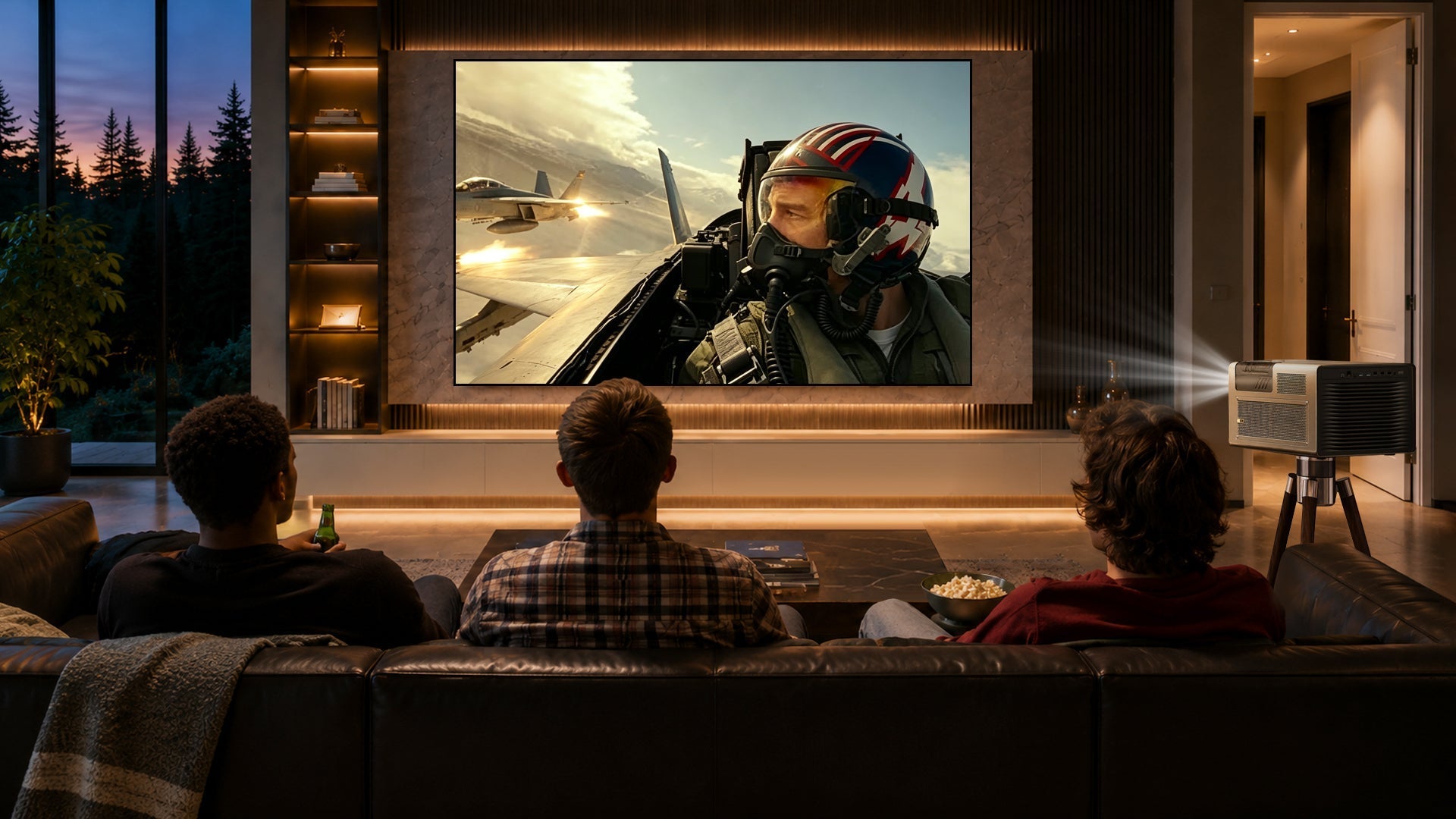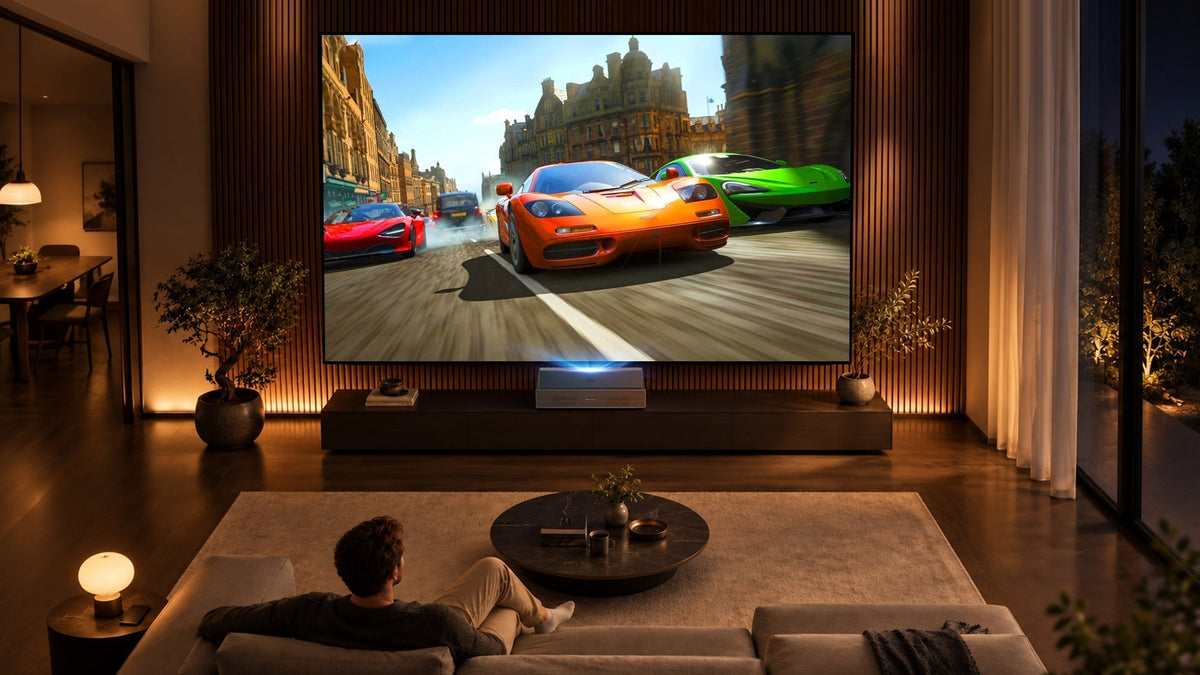




Berlin, September 2026. The world's largest consumer electronics show is in full swing, and if there's one category stealing the spotlight this year, it's ultra-short-throw (UST) projection. IFA 2026 has become the battleground for the next generation of home cinema — where RGB triple-laser engines, 4K 120Hz gaming, and once-unthinkable brightness levels are redefining what a "TV" can be.
But here's the catch: even the most advanced UST projector is only half the equation. The screen you pair it with determines whether that 5,500-lumen laser engine delivers a transformative experience or a disappointing compromise.
Let's start with what IFA 2026 revealed about the state of UST projection, then talk about why the screen matters more than ever — and how NothingProjector's Black Series is the perfect companion for these new-generation projectors.
What Is IFA — And Why Does It Matter?
IFA (Internationale Funkausstellung) is Europe's largest and oldest consumer electronics trade show, held annually in Berlin. Since its inception in 1924, it has served as the global stage where the world's leading electronics brands unveil their most significant innovations. From September 4-8, 2026, IFA Berlin hosted over 1,800 exhibitors and drew hundreds of thousands of attendees from across the globe.


For the home theater industry, IFA is the calendar's most important event — a place where trends are set, technologies are launched, and the future of how we watch content is shaped. This year, that future is decidedly ultra-short-throw.
The IFA 2026 UST Heavyweights: Three Flagships That Redefine the Category
Three projectors dominated the UST conversation at IFA 2026: the Hisense L9Q Pro, the AWOL Vision LuxVision, and the XGIMI AURA 3 Max. Each represents a different approach to premium projection, but all share one thing in common: they're pushing the boundaries of what's possible in a living room.

Hisense L9Q Pro: The Market Leader's Answer
Hisense has established itself as the global leader in large-screen entertainment, commanding a 55.2% market share in the 100-inch-and-above TV segment. The L9Q Pro is the company's flagship laser TV, and it's a statement of intent.
At its core is Hisense's TriChroma RGB triple-laser system, using dedicated red, green, and blue laser light sources rather than a single laser with a color wheel. The result is spectacular color reproduction: 118% of the BT.2020 color volume and support for approximately 1.07 billion colors.

Brightness is the headline feature. At 5,500 ANSI lumens, the L9Q Pro is designed to deliver impactful images even at enormous screen sizes. A 7-level adjustable IRIS with two preset modes helps users balance brightness and black-level performance for different room conditions, with contrast rated at up to 6,000:1 when the IRIS is engaged.

Image size ranges from 80 inches all the way to 200 inches — an unusually broad range enabled by an extremely short 0.18:1 throw ratio. At 120 inches, the projector sits just 8.5 inches from the screen; at 150 inches, it's 13.2 inches away.
Installation flexibility gets a major upgrade with ±5% vertical lens shift — a rare feature in UST projectors that allows image position adjustment without physically moving the unit.
The L9Q Pro also supports Dolby Vision, HDR10+, IMAX Enhanced, Filmmaker Mode, Active 3D, and features 116W Devialet-tuned audio. It uses a 0.47-inch DMD chipset with pixel-shifting technology to produce a 4K UHD image.
Price: Approximately $5,998

AWOL Vision LuxVision: The Gaming Pioneer
AWOL Vision has positioned itself as a pioneer of RGB triple-laser UST technology, and the LuxVision — unveiled at IFA 2026 — takes that reputation to new heights.
The LuxVision's headline claim is being the world's first UST projector to combine native 4K resolution at 120Hz with a true optical lens shift mechanism. This is a game-changer for both setup and gaming.
Optical lens shift allows users to move the internal optical assembly directly, enabling precise image positioning without the pixel cropping and blur inherent in digital keystone correction. For UST owners who've struggled with alignment, this is transformative.
For gamers, the LuxVision delivers 4K at 120Hz with input lag as low as 1 millisecond. The port selection is gaming-optimized: three HDMI 2.1 inputs, a dedicated DisplayPort, and a four-channel HDMI Multiview mode for running multiple sources simultaneously. Support for ALLM, VRR, and Dolby Vision Gaming completes the package.

The RGB triple-laser engine outputs 6,000 ISO lumens, maintaining vivid contrast even in sunlit rooms. Color coverage reaches 100% of the Rec.2020 space, with support for dynamic tone mapping, Dolby Vision, and IMAX Enhanced.
Image size reaches up to 200 inches with a 0.18:1 throw ratio. A second-gen anti-rainbow processing system helps eliminate visual fatigue during long viewing sessions.
Price: $5,999 / €5,999
XGIMI AURA 3 Max: The Disruptor
XGIMI arrived at IFA 2026 with a clear mission: democratize 4K 120Hz UST projection. The AURA 3 Series — consisting of the AURA 3 Max and AURA 3 Pro — is positioned as the world's first 4K 120Hz UST projector lineup.
The AURA 3 Max features an RGB Triple Laser light engine paired with XGIMI's Dynamic Dual Iris technology — two dynamically controlled optical apertures that regulate light to deliver deeper blacks and higher contrast. Native contrast reaches an impressive 8,000:1.
Brightness hits 5,700 ISO lumens for the Max model. The projector covers 110% of the BT.2020 color gamut and supports Dolby Vision, HDR10+, HLG, IMAX Enhanced, and Filmmaker Mode.
For gamers, the AURA 3 Max delivers 4K at 120Hz with VRR, ALLM, AMD FreeSync Premium, and Dolby Vision Gaming. Input latency drops as low as 1ms. Two DLPC 8545 display controllers operate in parallel to handle 4K at 120Hz.
The 0.163:1 throw ratio projects a 120-inch image from just 8 inches away, with support for screen sizes up to 200 inches. Audio comes from an 80W Harman Kardon speaker system with Dolby Atmos. The projector runs Google TV out of the box with native access to all major streaming services.
Price: $2,399 (Kickstarter exclusive)
📊 Flagship Comparison Matrix: IFA 2026 Heavyweights
| Flagship Feature | Hisense L9Q Pro | AWOL Vision LuxVision | XGIMI AURA 3 Max |
|---|---|---|---|
| Light Engine | TriChroma RGB Triple-Laser | Pure RGB Triple-Laser | RGB Triple-Laser |
| Brightness | 5,500 ANSI Lumens | 6,000 ISO Lumens | 5,700 ISO Lumens |
| Native Contrast | Up to 6,000:1 (7-level IRIS) | High Native Contrast | 8,000:1 (Dynamic Dual Iris) |
| Color Gamut | 118% BT.2020 (1.07B colors) | 100% Rec.2020 | 110% BT.2020 |
| Gaming Specs | 4K Pixel-Shift, Fast Response | Native 4K @ 120Hz, 1ms Lag, VRR/ALLM | Native 4K @ 120Hz, 1ms Lag, FreeSync |
| Lens Shift | ±5% Vertical Lens Shift | True Optical Lens Shift Assembly | Precision Auto Alignment |
| Throw Ratio | 0.18:1 (120" @ 8.5") | 0.18:1 (Up to 200") | 0.163:1 (120" @ 8") |
| Audio Architecture | 116W Devialet Audio | Premium Stereo with Atmos | 80W Harman Kardon with Atmos |
| Price Reference | ~$5,998 | $5,999 / €5,999 | $2,399 (Kickstarter) |
The Common Thread: What These Flagships Share
Beyond their individual strengths, these three projectors reveal clear trends shaping the UST category:
- RGB Triple-Laser Is Now Standard — All three use dedicated red, green, and blue laser light sources, delivering wider color gamuts and more accurate color reproduction than single-laser or LED-hybrid systems.
- 4K 120Hz Is the New Baseline — Gaming is driving this. All three support 4K at 120Hz with VRR and ALLM, making UST projectors legitimate alternatives to gaming displays.
- Brightness Is Climbing Fast — With outputs ranging from 5,500 to 6,000 lumens, these projectors can hold their own in rooms with significant ambient light.
- Optical Lens Shift Is Emerging — Hisense and AWOL both introduced vertical optical lens shift at IFA 2026, solving one of UST's biggest setup headaches.
- 200 Inches Is the New 100 Inches — All three support images up to 200 inches, pushing UST projection into "wall-filling" territory.

UST Projector vs. TV: The Real Differences
With projectors this capable, the old question resurfaces: Why buy a TV when you can have a 120-inch or 200-inch image?
The answer has shifted dramatically. Traditional wisdom held that TVs win for everyday viewing — brighter, sharper in daylight, easier to live with. Projectors won for cinema-style moments: massive images and immersive experiences.
But with 5,500+ lumens and 95% ALR screens, UST projectors with ambient-light-rejecting screens can now hold their own in brighter rooms. The gap has narrowed considerably.
Here's where the real differences lie today:
- Image Size — This is the projector's superpower. A 98-inch TV requires a massive piece of furniture and dedicated wall space. A UST projector can deliver 120, 150, or 200 inches from a compact unit sitting on a media console. TVs simply cannot compete at these sizes without becoming prohibitively expensive and logistically challenging.
- Installation — TVs are simpler out of the box: mount it or place it, plug it in, and you're done. UST projectors require careful alignment, proper screen pairing, and consideration of ambient light. That said, the optical lens shift appearing in new models is making setup dramatically easier.
- Contrast and Black Levels — High-end OLED TVs still produce deeper blacks and more punchy contrast in completely dark rooms. However, with ALR screens and advanced IRIS systems, UST projectors are closing this gap — the AURA 3 Max's 8,000:1 native contrast is genuinely impressive.
- Power Consumption — A UST projector typically consumes 180–300W in real-world use. An 85-inch TV can range from 250–450W depending on technology and brightness. Projectors have a slight efficiency edge at large sizes.
The Bottom Line — If you want the absolute best image quality in a dark room with no size constraints, an OLED TV is still king. If you want a genuinely cinematic experience — 120 inches or larger — in a living room that doesn't revolve around a massive black rectangle, a UST projector with a quality ALR screen is now a compelling alternative.
Screen Size and the ALR Imperative
All three projectors support screen sizes from approximately 80 inches up to 200 inches. That's an enormous range, and it's where the screen decision becomes critical.
Here's the reality: even the most advanced UST projector cannot deliver its best image without a proper ALR screen.
Projecting onto a white wall might work in a completely dark room, but in a real living room — with windows, ambient light, and everyday living — the image will wash out. Blacks become grays. Colors lose saturation. Contrast evaporates.
An ambient light rejecting (ALR) screen solves this by selectively reflecting light from the projector while rejecting light from other angles — ceiling lights, windows, and side lighting. Without it, you're leaving 50% or more of your projector's performance on the table.
NothingProjector Black Series: The Perfect Companion for Next-Gen UST
This is where NothingProjector enters the picture. The Black Series ALR screens are purpose-built for the new generation of high-brightness UST projectors — including the Hisense L9Q Pro, AWOL Vision LuxVision, and XGIMI AURA 3 Series.
Black Series Fixed Frame Screen
The Black Series fixed frame screen is designed for permanent installation, delivering professional-grade ALR performance.
| Specification | NothingProjector Black Series Fixed Frame |
|---|---|
| Ambient Light Rejection | Up to 95% |
| Contrast Ratio | 1000:1 |
| Viewing Angle | 170° |
| Material | Premium HBST PET with ST Carbon Black coating |
| Resolution Support | 4K, 8K UHD |
| Available Sizes | 84" to 150" |

The ST Carbon Black optical layer is the heart of the Black Series — a high-temperature-treated optical coating designed to absorb stray light and minimize reflection. The result? Deeper blacks, richer contrast, and incredible depth, especially in dark scenes.
With up to 95% ambient light rejection, the Black Series filters ceiling and side lighting, allowing your UST projector to shine even in modern living rooms where blackout curtains simply aren't an option.
The 170° viewing angle ensures consistent, vibrant pictures from anywhere in the room — ideal for family viewing or entertaining.
Black Series Motorized Floor Rising Screen
For those who want a screen that disappears when not in use, the Black Series motorized floor rising screen offers the same 95% ALR performance in a retractable format.
| Specification | NothingProjector Black Series Floor Rising |
|---|---|
| Ambient Light Rejection | Up to 95% |
| Material | Premium HBST PET |
| Viewing Angle | 170° |
| Motorized Operation | RF remote + projector trigger |
| Available Sizes | 84" to 130" |

With one touch of a button — or automatically triggered by your projector — the screen rises from its base, delivering a professional-grade home cinema experience. When you're done, it retracts into a compact footprint, keeping your living space clean and uncluttered.
The screen features a perforated acoustic aperture (0.4mm) that allows 3D stereo surround sound to pass through the screen material, eliminating the "blocked" feeling of sound behind a solid surface.
The Black Series Advantage
When you're investing $2,400 to $6,000 in a flagship UST projector, the screen should not be an afterthought. The NothingProjector Black Series ensures you're getting the full performance your projector is capable of delivering — with 95% ambient light rejection, 1000:1 contrast, and the ST Carbon Black layer that makes blacks truly black.
The NothingProjector Motorized UST Cabinet
For the complete installation, NothingProjector also offers the Shore Flip Design Matte Smart Laser TV Cabinet — a pre-assembled motorized cabinet designed specifically for UST projectors. This elegant solution conceals your projector when not in use and reveals it with a motorized mechanism when it's time for movie night, keeping your living space clean and your equipment protected.

Final Thoughts: The Golden Age of UST Is Here — But Don't Forget the Screen
IFA 2026 has made one thing clear: UST projection has entered a new era. With 5,500+ lumens of brightness, 4K 120Hz gaming, RGB triple-laser color, and optical lens shift, these projectors are genuinely competitive with — and in some ways superior to — traditional TVs for large-screen home entertainment.
But the projector is only half the equation. An ALR screen is not an accessory — it's an essential component that determines whether your investment delivers its full potential.
The NothingProjector Black Series — with its 95% ambient light rejection, ST Carbon Black optical layer, and premium HBST PET material — ensures that these new-generation UST projectors perform at their absolute best. Whether you choose the fixed frame for a permanent installation or the motorized floor rising model for maximum flexibility, the Black Series is the screen these projectors deserve.
After all, what's the point of 5,700 lumens if you can't see them?