



JMGO at IFA 2026: A Statement of Intent
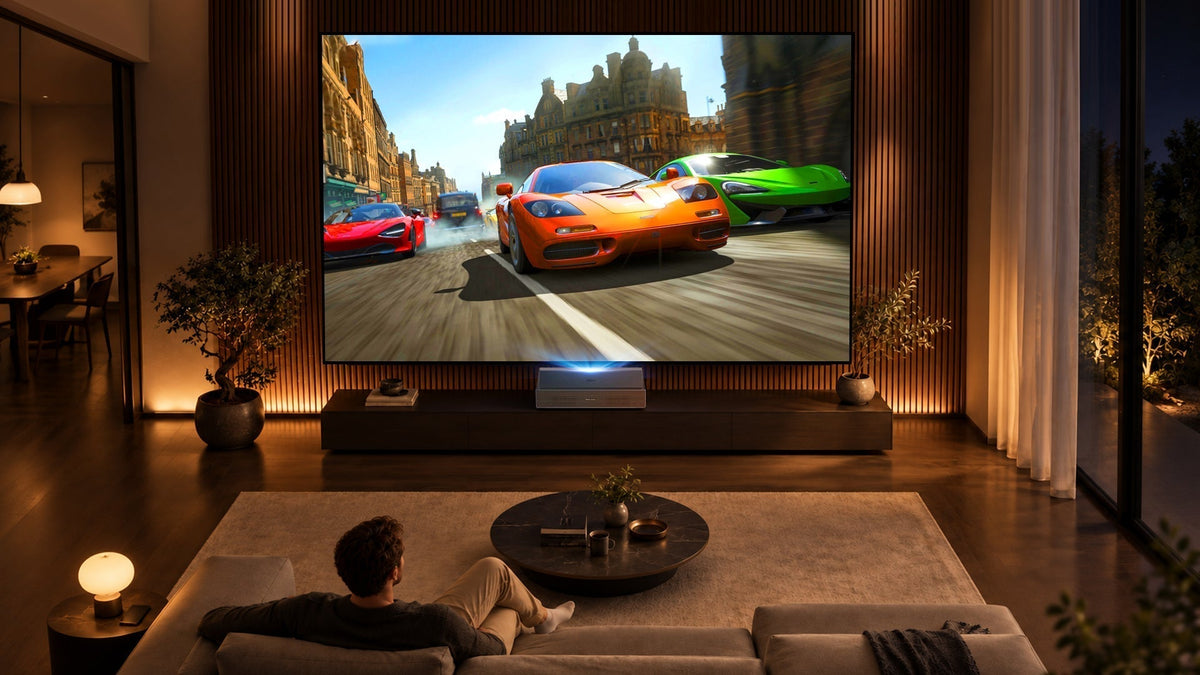
The global projector market reached $6.8 billion in 2025 and is on track to hit $14.7 billion by 2034, growing at a compound annual growth rate of 8.9%. Within this rapidly expanding landscape, JMGO has positioned itself as one of the most disruptive forces in laser projection technology. At IFA Berlin 2026, the brand made its most significant global statement yet with the debut of the IRIS Series — the world's first smart projector line to deliver true 4K resolution at a full 120Hz refresh rate.
JMGO's journey into Western markets has been aggressive and calculated. Backed by Oppo and armed with over 400 patents, the company has leveraged strategic retail partnerships — including entry into Costco Canada in late 2025 with planned Costco USA expansion — and pricing strategies that undercut legacy competitors by as much as 56% during promotional periods. The IRIS Series builds on this momentum. The underlying 4K@120Hz platform first launched in China in May 2026, where it sold more than 5,000 units within three months, validating both the technology and the demand before the global rollout.


Strategically, the IRIS launch signals JMGO's intention to move beyond the "affordable alternative" narrative. In the first half of 2026, JMGO ranked second in revenue among Chinese smart projector brands but fell to fifth by unit sales — a position that reflects the company's deliberate prioritization of premium positioning over mass-market volume. The IRIS Series is designed to compete at the highest tier of home projection, directly challenging established flagships from XGIMI, Dangbei, and Epson. The move comes at a pivotal moment: IFA 2026 marked what industry analysts have called the "commercial debut year" for true 4K@120Hz projection, with multiple brands simultaneously breaking the longstanding 60Hz barrier.
JMGO IRIS Ultra Max: The Flagship That Means Business
Display Technology and Image Quality
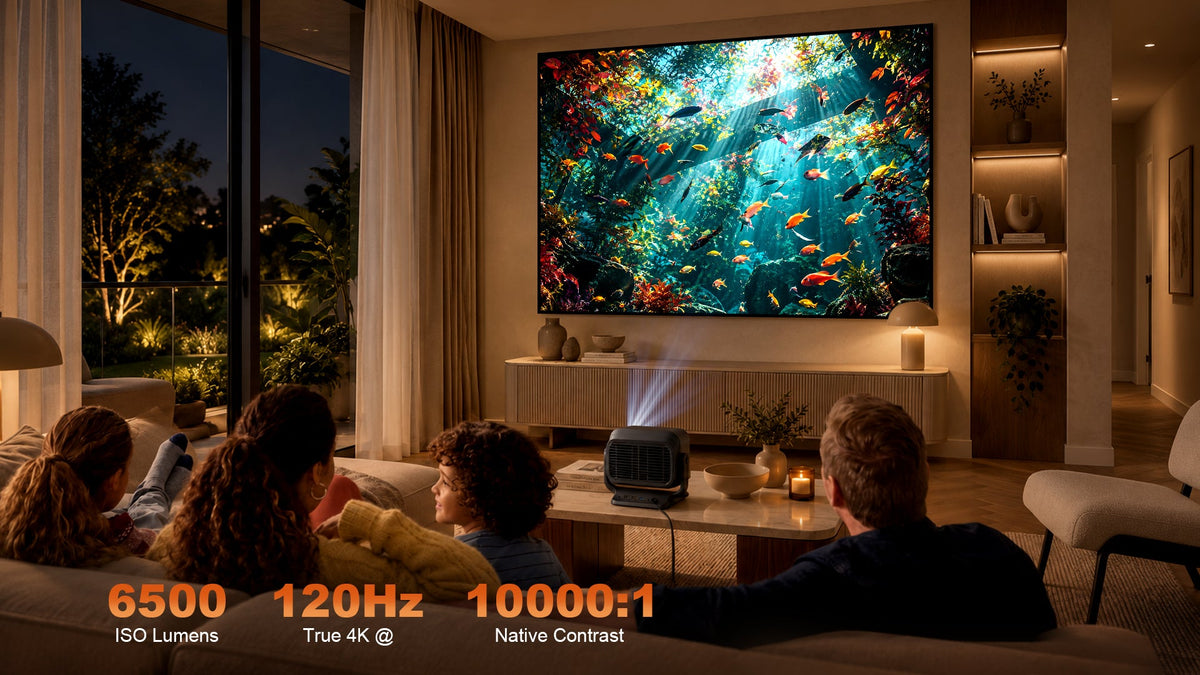
At the heart of the IRIS Ultra Max sits JMGO's MALC 6.0 Triple-Laser Engine, a next-generation optical platform that combines three independent laser sources — one per primary color — to deliver cinema-grade image quality. The projector achieves 6,500 ISO lumens of brightness and a 10,000:1 native contrast ratio, placing it among the brightest and most contrast-capable consumer projectors on the market. These figures carry real-world significance: 6,500 ISO lumens is sufficient for comfortable daytime viewing in rooms with substantial ambient light, a scenario where most projectors below 3,000 lumens struggle visibly.

Color performance is equally impressive. The IRIS Ultra Max covers approximately 110% of the BT.2020 color gamut — the standard for UHD broadcast content — and achieves a ΔE of around 0.7, indicating color accuracy that professional calibrators would consider reference-grade for consumer hardware.
 The projector's dual-IRIS system with a 15-blade (6+9) configuration improves stray-light suppression by 11.34% compared to a 12-blade (6+6) design, directly contributing to deeper blacks and stronger perceived contrast. Six adjustable iris levels allow users to adapt brightness and contrast to different content types and viewing environments, from dimly lit movie nights to afternoon sports broadcasts.
The 4K@120Hz Advantage
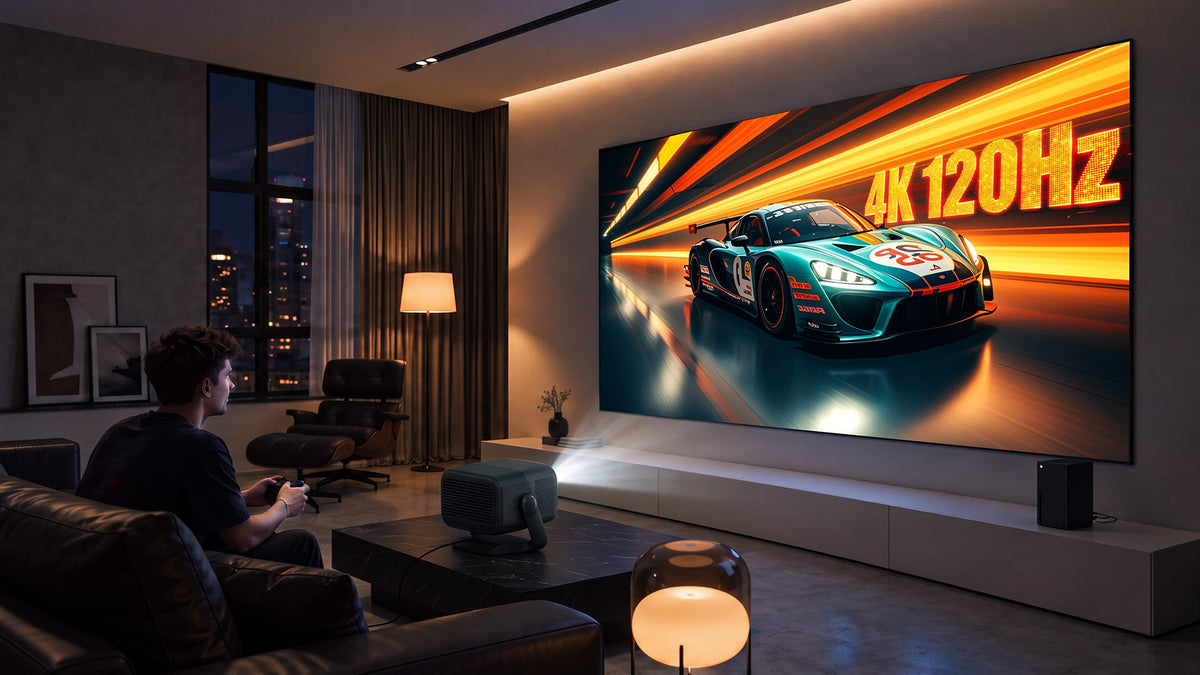
What genuinely sets the IRIS Series apart is its end-to-end 4K@120Hz pipeline. Powered by a dual-DLPC architecture and the HyperPulse Actuator — which shifts at 480 times per second — the projector maintains full 4K detail at 120Hz from HDMI input to screen output. This matters for two critical use cases:

- Gaming: VRR (Variable Refresh Rate) and ALLM (Auto Low Latency Mode) support enables compatible consoles and PCs to run games at up to 120 frames per second with reduced screen tearing and input lag. JMGO claims the IRIS Series is the first projector to support Dolby Vision at full 4K@120Hz, combining high-refresh gaming performance with the dynamic HDR format that delivers scene-by-scene brightness and color optimization.
- Movies and Sports: 4K@120Hz MEMC (Motion Estimation and Motion Compensation) keeps fast action — ball trajectories, camera pans, high-speed chases — smooth and clear without the judder that plagues 60Hz projection. Hardware-level Anti-RBE (Anti-Rainbow Effect) technology reduces the rainbow artifacts that DLP projectors have historically produced, doing so without adding operating noise.
Optical Flexibility and Placement
The IRIS Ultra Max features a 3-in-1 optical system that addresses one of the most persistent pain points in projector ownership: placement flexibility. This system combines a 0.88–1.7:1 optical zoom, four-way lens shift (vertical ±130%, horizontal ±53%), and an AI-powered motorized gimbal capable of 360° pan and 150° tilt.

The practical benefit is substantial. Digital keystone correction — the software workaround most projectors rely on — works by cropping and stretching the image, which softens detail and introduces artifacts. The IRIS Ultra Max's optical lens shift physically repositions the lens elements, maintaining native image quality without digital degradation. The motorized gimbal extends this flexibility further, allowing the projector to aim at different walls or even ceilings without manual repositioning. AI Screen Fitting automatically adjusts the image to match the screen, while AI Spatial Image Memory remembers projection positions and associated applications, eliminating tedious recalibration when the projector is moved between rooms.
JMGO IRIS Ultra: The Smart Value Proposition
The IRIS Ultra delivers the same core 4K@120Hz technology as its flagship sibling at a significantly more accessible price point. The critical specifications: 4,500 ISO lumens, 7,000:1 native contrast, and identical color gamut coverage at 110% of BT.2020.
The trade-offs are deliberate and, for many users, entirely reasonable. The Ultra drops the motorized AI gimbal, retaining lens shift but without 360° pan and 150° tilt capability. Brightness falls from 6,500 to 4,500 ISO lumens — still enough for comfortable daytime viewing in smaller spaces, though the Ultra Max maintains a clear advantage in larger rooms and high-ambient-light environments. Contrast drops from 10,000:1 to 7,000:1, a difference that becomes most noticeable in dark-scene detail and black-level uniformity.

Early-bird pricing reflects this positioning: $1,899 for the IRIS Ultra versus $2,999 for the IRIS Ultra Max (MSRP $2,399 and $3,499 respectively). For gamers and home theater enthusiasts who prioritize the 4K@120Hz pipeline over absolute brightness and placement automation, the IRIS Ultra represents one of the most compelling value propositions in the current projector market.
Both models share the same dual-DLPC architecture, HyperPulse Actuator, Anti-RBE technology, and VRR/ALLM gaming features. The IRIS Series as a whole begins shipping October 19, 2026, with pre-orders opened at IFA.
How the IRIS Series Stacks Up Against the Competition
To properly assess the IRIS Series' competitive positioning, it's useful to compare it directly against the most relevant alternatives — both ultra-short-throw (UST) models like XGIMI's AURA 3 Max and long-throw alternatives from Dangbei.
| Feature | JMGO IRIS Ultra Max | JMGO IRIS Ultra | XGIMI AURA 3 Max | Dangbei S7 Ultra Max |
|---|---|---|---|---|
| Projector Type | Portable long-throw | Portable long-throw | UST (fixed) | Long-throw |
| Resolution & Refresh | 4K @ 120Hz | 4K @ 120Hz | 4K @ 120Hz | 4K (60Hz) |
| Brightness | 6,500 ISO lumens | 4,500 ISO lumens | 5,700 ISO lumens | 5,800 CVIA lumens |
| Native Contrast | 10,000:1 | 7,000:1 | 8,000:1 | 8,000:1 |
| Light Source | Triple Laser (MALC 6.0) | Triple Laser (MALC 6.0) | Triple Laser | Triple Laser |
| Dolby Vision @ 4K@120Hz | Yes | Yes | Yes | Yes (4K@60Hz) |
| VRR / ALLM | Yes | Yes | Yes | Limited |
| Optical Adjustment | Zoom + Lens Shift + AI Gimbal | Zoom + Lens Shift | Fixed UST | Optical Zoom |
| Throw Ratio | 0.88–1.7:1 | 0.88–1.7:1 | 0.163:1 | 0.98–1.6:1 |
| Built-in OS | JMGO OS | JMGO OS | Google TV | Android (China) |
| Price (MSRP) | $3,499 | $2,399 | ~$3,499 (est.) | ~$2,500 (est.) |
Key competitive takeaways:
The IRIS Ultra Max's 6,500 ISO lumens represents the highest brightness rating in its class, exceeding the XGIMI AURA 3 Max by approximately 14% and providing a measurable advantage in rooms with uncontrolled ambient light. The AURA 3 Max compensates with its UST form factor — projecting a 120-inch image from just 8 inches away — and integrated 80W Harman Kardon speakers with Dolby Atmos, making it a compelling choice for users who want a fixed, furniture-integrated setup. The two products target genuinely different use cases: the AURA 3 Max is designed for permanent installation, while the IRIS Ultra Max is built for flexibility and movement.
The Dangbei S7 Ultra Max, priced around $2,500, offers 5,800 CVIA lumens and an 8,000:1 native contrast ratio but lacks the 120Hz refresh rate that defines the IRIS Series' core value proposition. For gamers and sports enthusiasts, this is a significant limitation. For pure movie watching in a dedicated dark room, the Dangbei remains a legitimate contender.
Perhaps the IRIS Ultra's most interesting competitive position is against its own flagship sibling. At $1,899 (early-bird), it undercuts the Ultra Max by over $1,000 while preserving the full 4K@120Hz pipeline. The brightness and contrast reductions are real but manageable for users in smaller, light-controlled rooms. For value-conscious buyers who don't need the motorized gimbal, the IRIS Ultra may well be the smarter purchase.
Why Your IRIS Projector Deserves More Than a Blank Wall
A projector of the IRIS Series' caliber — with 6,500 ISO lumens, 10,000:1 native contrast, and 110% BT.2020 color coverage — represents a significant investment in image quality. Pairing it with a bare white wall is, quite simply, leaving performance on the table.
The Physics of Projection Surfaces
The fundamental difference between projecting onto a wall and projecting onto a purpose-engineered screen lies in how light is managed. A matte white wall scatters incident light in all directions — including ambient light from windows, ceiling fixtures, and off-axis sources. This ambient light washes over the projected image, lifting black levels toward grey and desaturating colors. The result is a visibly flatter, less dynamic picture, even from a high-brightness projector.
A proper projection screen, by contrast, is engineered to control light directionally. Matte white screens with gains around 1.3 provide a modest boost in perceived brightness and improved color uniformity compared to typical wall surfaces, while maintaining wide viewing angles suitable for family viewing. Ambient Light Rejecting (ALR) and Ceiling Light Rejecting (CLR) screens go further: their micro-structured lenticular surfaces reflect projector light directly toward the seating position while absorbing or deflecting ambient light from overhead or off-axis sources. This doesn't change the projector's native contrast ratio — it simply prevents ambient light from washing out the image, preserving the dark-scene detail and black-level performance that the IRIS Ultra Max's 10,000:1 contrast is capable of delivering.
NothingProjector: Premium Screens Without the Premium Markup
For IRIS Series owners seeking to maximize image quality without overspending on a screen that costs as much as the projector itself, NothingProjector has established itself as a brand known for delivering professional-grade projection surfaces at accessible price points.

ALR Long Throw Screen for UST Projectors
NothingProjector's ALR long throw frame screen pairs exceptionally well with the IRIS Series. Reviewers have praised its "first-rate ceiling light rejection" and clean, high-contrast image when properly matched with a bright projector. The screen's 0.6-gain surface is specifically designed to work with projectors capable of 2,500+ lumens — a threshold the IRIS Ultra Max (6,500 ISO lumens) and IRIS Ultra (4,500 ISO lumens) both comfortably exceed. In dark-room conditions, the screen renders black levels that genuinely enhance perceived contrast, with the image appearing to "float" even under ceiling lights.
The Black Series features a minimalist fixed-frame design with a lightweight aluminum frame and a straightforward one-person assembly process. Available in 100-inch and 120-inch sizes, it delivers the kind of performance that competes with screens costing significantly more.
Matte White Motorized Floor Rising Screen
For users who value flexibility and the ability to reclaim their living space after viewing, NothingProjector's matte white floor-rising screen is a compelling alternative. This motorized screen rises from a discreet floor housing and retracts when not in use, making it ideal for multi-purpose rooms, rental properties, or spaces where a permanent installation isn't practical.
The screen features a 1.3-gain matte white surface with a Tab-Tension system for consistent flatness, and a 170° viewing angle that accommodates multiple seating positions. At approximately €799 for the 100-inch version and €999 for the 120-inch version, it undercuts comparable motorized screens from premium brands by a substantial margin. Reviewers have noted that while it may produce a slight initial smell, the overall build quality and image performance represent excellent value.
For IRIS Series owners, the choice between the long throw fixed frame and the matte white floor-rising screen comes down to priorities: maximum image quality and permanent installation versus flexibility and space optimization. Both represent significant upgrades over projecting onto a bare wall, and both allow the IRIS Series' 4K@120Hz, triple-laser image quality to perform at its full potential.
The Bottom Line
The JMGO IRIS Series marks a genuine inflection point for home projection. By delivering true 4K@120Hz from input to output — a first for any smart projector line — JMGO has closed the refresh-rate gap that has separated projectors from the gaming monitors and premium TVs they compete with for living room attention. The IRIS Ultra Max stands as one of the brightest, most color-accurate long-throw projectors available, while the IRIS Ultra brings the same core technology to a broader audience without meaningful compromises for most viewing scenarios.
Combined with a purpose-built screen from NothingProjector — whether the Black Series for fixed installations or the matte white floor-rising screen for flexible setups — the IRIS Series becomes a complete home theater solution capable of delivering reference-grade 4K@120Hz performance in a variety of real-world environments.
For gamers, film enthusiasts, and anyone who has been waiting for projector technology to catch up with the rest of their home entertainment gear: the wait is over.