


You saw them at IFA 2026. The ultra-short-throw category exploded with genuine flagship hardware this year. AWOL Vision unveiled the LuxVision — the world's first 4K 120Hz UST projector with optical lens shift, 6,000 ISO lumens, and an RGB triple-laser engine priced at €5,999. Hisense countered with the L9Q Pro, a 5,500 ANSI lumen RGB laser powerhouse featuring a 0.18:1 throw ratio, 6,000:1 native contrast, 118% BT.2020 coverage, and Dolby Vision with a Devialet-tuned Dolby Atmos audio system. XGIMI debuted the AURA 3 series — the AURA 3 Max and AURA 3 Pro — claiming the title of world's first native 4K/120Hz UST projector, with the Max model pushing 5,700 ISO lumens from a triple-laser dual IRIS setup and X-VISION AI processing, while also expanding its lifestyle laser lineup with the MIRA 3. Epson expanded its laser lineup with the EH-LS7500 short-throw model alongside the EH-LS5000, EH-LS6000, and EH-LS7000, all powered by AI-driven real-time image optimisation.
You pre-ordered one of them. Maybe the LuxVision with its optical shift engine. Or the L9Q Pro with Devialet sound. You cleared the perfect spot in your living room. And then you projected onto a white wall.
The image looked washed out, grey, and flat. Blacks turned to muddy charcoal the moment a window curtain stayed open. Your €5,000-plus investment suddenly felt like a €500 budget projector.
Here is the hard optical truth that every UST projector owner learns eventually: your projector's light source determines the ceiling of your image quality, but your screen determines the floor. No matter how many ISO lumens your laser engine pushes, a white wall or a standard matte white screen will reflect ambient light with the same enthusiasm it reflects your projected image. The result is a contrast ratio collapse — blacks rise, colours desaturate, and the cinematic experience evaporates.

This is where an Ambient Light Rejecting (ALR) or Ceiling Light Rejecting (CLR) screen becomes not an accessory, but a necessity.
The Physics of Light Rejection: How ALR Screens Actually Work
An ALR screen is not simply a darker fabric. It is a precision optical filter engineered to distinguish between light coming from your projector and light coming from the rest of the room. The core principle is directional reflectivity. Unlike a white wall, which scatters light in all directions according to the Law of Reflection, an ALR surface uses microscopic structures to redirect or absorb off-axis light while preserving the projection beam.
Two dominant architectures exist for ultra-short-throw projectors: Black Grid (Lenticular) ALR and Fresnel Optical ALR.
Black Grid ALR: The Sawtooth Strategy

Black grid screens — often called CLR screens — feature a sawtooth microstructure across the surface. The upper face of each microscopic tooth is coated in a black light-absorbing layer, while the lower face is a reflective white or grey layer.
When ambient light from ceiling fixtures or windows hits the screen from above, it strikes the black absorbing surface and is neutralised. But projection light from a UST projector arrives from below at a steep upward angle. It bypasses the black layer and hits the reflective lower face, which directs it toward the viewer. The result is a screen that behaves like a one-way optical valve: ambient light dies, projected light survives.
NothingProjector's Black Series fixed frame ALR screen applies this lenticular architecture with a 95% ambient light rejection rating, a wide 170-degree viewing angle, and ST Carbon Black coating on a premium HBST PET material. It is available in sizes from 84 to 150 inches, supports full 4K UHD and active 3D, and covers 99.7% of the Rec.709 colour gamut — making it one of the most versatile CLR solutions for modern living rooms.
Fresnel Optical ALR: The Concentric Lens

Fresnel screens take a different approach. Instead of sawtooth prisms, they use a series of concentric circular grooves that mimic the light-converging behaviour of a concave mirror, flattened into a single plane. This structure is specifically tuned to the steep projection angle of a UST projector.
The Fresnel geometry focuses projected light toward the viewing area while blocking light arriving from above and the sides. NothingProjector's Fresnel fixed frame ALR screen employs an eight-layer optical structure that achieves a 1.2 gain — meaning the screen actively amplifies perceived brightness rather than merely preserving it. It delivers 95% ambient light rejection, 99.7% Rec.709 colour gamut coverage, and is available in 100 to 120-inch sizes with a 90-degree viewing cone for maximum brightness concentration. Independent testing by @ProjectorJunkies recorded a real gain of 1.24 and confirmed that "when ceiling and side lights are turned on, the Fresnel is the winner in terms of overall ambient light rejection".
The Visual Chasm: Structural & Optical Comparison
The numbers behind ambient light rejection are not marketing abstractions. A 6,000-ANSI-lumen laser projector on a white wall can lose 35 to 45% of perceived brightness under typical room lighting. Contrast ratios that should reach 1,500:1 collapse to below 200:1. True optical surfaces perform on a fundamentally different level, as detailed below:
| Surface Type | Optical Structure & Principle | Ambient Light Rejection (ALR) | Gain Profile | Viewing Cone | Core Cinematic Impact |
|---|---|---|---|---|---|
| White Wall / Matte White | Flat surface. Scatters light in all directions according to the Law of Reflection. | 0% (Reflects environment light and projection light indiscriminately) | Neutral (1.0) | 180° (Uniform scattering) | Contrast collapses under ambient light; blacks turn grey, colours completely desaturate. |
| Grey Screen | Tinted passive surface. Blunt instrument to absorb stray light. | Marginal generic absorption (Fails directional filtering) | Negative (Sacrifices peak brightness) | Wide | Slightly improves black levels in dark scenes but severely dampens overall brightness. |
| Black Grid ALR (Lenticular) | Microscopic sawtooth structure. Upper black absorbing layer + lower grey/white reflective layer. | 95% (Engineered CLR / Absorbs overhead ceiling & window light) | Negative (0.4 – 0.6 typical for deep contrast) | 170° Wide Angle (Perfect for open-plan seating) | Delivers OLED-like deep black levels; keeps image structure pristine with ST Carbon Black. |
| Fresnel Optical ALR | Eight-layer optical stack with concentric circular grooves mimicking a flattened concave mirror. | 95% (High-efficiency directional convergence) | Positive (1.2 active amplification) | 90° Focused Cone (Brightness concentration) | Maximises perceived brightness; confirmed winner by independent lab testing in high ambient light rooms. |
Scenario Matching: Which Screen Architecture Fits Your Space?
For the Minimalist Living Room or Rental: Motorised Floor Rising

The problem: You want a 120-inch cinema experience, but you are not willing to mount a permanent black-framed rectangle on your wall. Your lease prohibits drilling. Your interior aesthetic leans toward clean Scandinavian or modern Japandi. A fixed frame screen would dominate the room and break the visual flow.
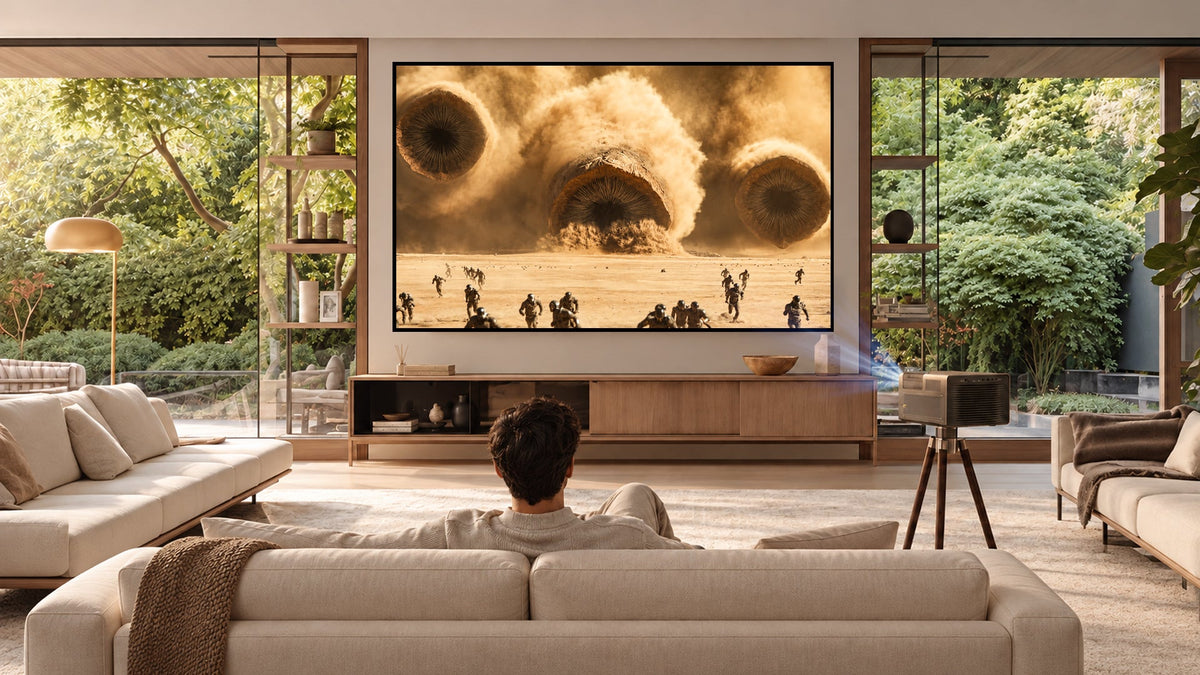
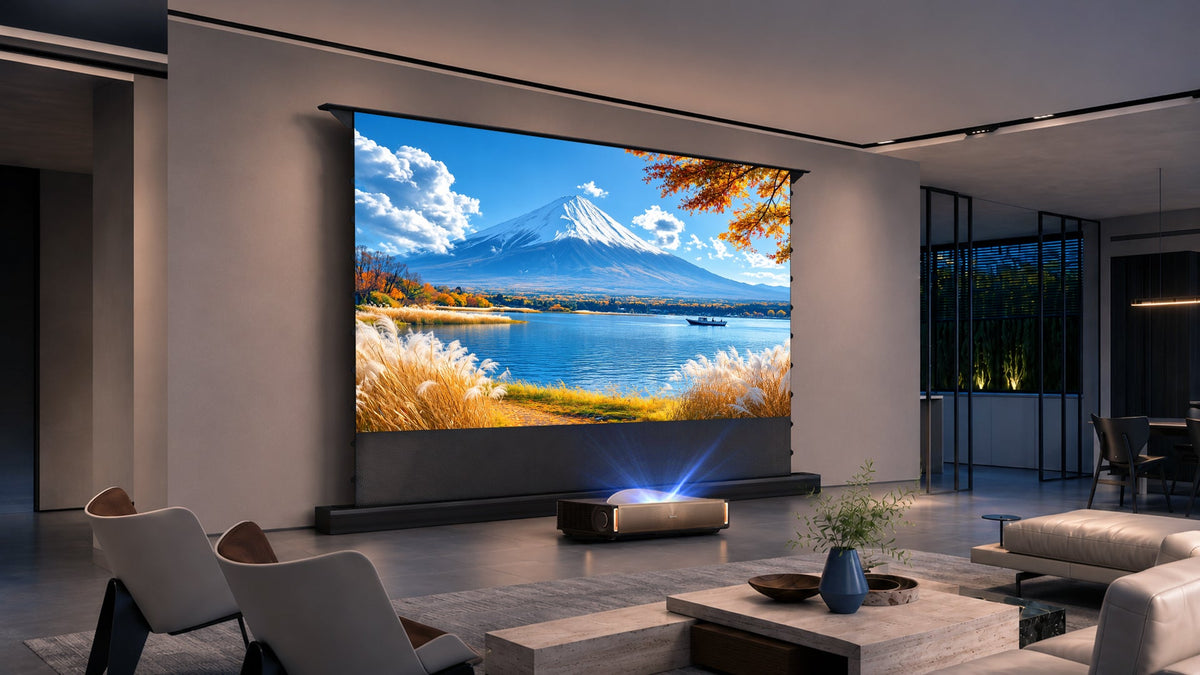
The solution: A motorised floor rising ALR screen. The NothingProjector Black Series floor rising ALR motorised screen rises from a discreet floor-level housing at the push of an RF remote button. When the movie ends, it retracts back into the cabinet or floor recess, leaving nothing behind but clean lines and open space.
The 84"–130" Black Series floor rising screen features a 95% ALR surface with a Premium HBST PET material that delivers full 4K UHD resolution and a wide viewing angle. A perforated acoustic aperture of 0.4mm along the bottom black border prevents the "blocking feeling" that can occur when a screen sits in front of a soundbar or centre channel, ensuring 3D stereo surround sound passes through without obstruction. A separate Black Series floor rising configuration offers 85% ALR with a 0.85 gain and an expansive 178-degree viewing angle across 84 to 120-inch sizes — ideal for open-plan spaces where viewers may sit far off-axis. It is compatible with leading UST projectors including the Hisense L9Q Pro, AWOL Vision LuxVision, and XGIMI AURA 3 series.
This is the zero-compromise, zero-damage solution for renters and design-conscious households in Europe's open-plan apartments.
For the Dedicated Home Cinema: Fixed Frame

The problem: You have a dedicated media room, or your living room features a full accent wall that begs for a statement piece. You want the tension, the permanence, and the purity of a traditional cinema screen — but with modern ALR performance.
The solution: A fixed frame ALR screen. Both the NothingProjector Black Series lenticular fixed frame and the Fresnel fixed frame deliver uniform tension across the entire surface, eliminating wrinkles and edge distortion. The Fresnel variant, with its 1.2 gain and eight-layer optical stack, is the preferred choice for bright rooms where maximum perceived brightness is the priority.
For darker, controlled environments, the Black Series lenticular fixed frame offers the deeper black levels that cinephiles demand. A 95% ALR/CLR rating means that even with a side lamp on, the image retains its cinematic authority.

Bring the Cinema Home This Season — Without the Guesswork
The Northern Hemisphere is sliding into autumn. Halloween movie marathons, Thanksgiving football weekends, and long winter evenings are approaching. Your living room is about to become the most-used entertainment venue in the house.
NothingProjector is making the upgrade frictionless for European and international customers. Orders ship from local warehouses in Europe, North America, and Australia, with 4–7 working day delivery to EU addresses and no tariff charges on standard orders. Split your purchase into three interest-free payments with Klarna, Shop Pay, or After Pay directly at checkout.
And for a limited time, use discount code NPHW at checkout to unlock exclusive savings on your ALR screen upgrade.
Your projector has already done the hard work. It has the lumens, the laser engine, and the 4K resolution. All it needs now is a surface that respects the light it produces. Stop fighting your room. Start directing the light.