



Walk into any premium home theater showroom today, and you'll likely hear one name dominating the conversation around large-screen displays: Hisense. But is the company's claim as the "global leader" in laser TV legitimate marketing hype, or is there real substance behind it?
The short answer is yes—and the data speaks for itself. But leadership isn't just about market share. It's about technological innovation, patent dominance, industry standard-setting, and real-world performance that outshines competitors like Samsung and Epson.
This article breaks down exactly why Hisense has earned its laser TV crown, compares its flagship models against the competition, and explains why pairing your ultra-short-throw (UST) laser TV with a high-quality ALR (Ambient Light Rejecting) screen—like the NothingProjector Black Series 95% ALR Motorized Floor Rising Screen—is absolutely essential to unlocking the full potential of these remarkable displays.
The Numbers That Define Hisense's Laser TV Dominance
Market Share: A Seven-Year Reign
According to Omdia data, Hisense commanded a staggering 70.3% global market share in the laser TV segment for the full year 2025. This marks seven consecutive years (2019–2025) that Hisense has held the number one position in global laser TV shipments.
To put this in perspective:
- In 2024, Hisense's share stood at 65.8%—meaning nearly two out of every three laser TVs sold worldwide were Hisense.
- In the first three quarters of 2025, the share was 69.7%, closing the year at 70.3%.
- Hisense also dominated the 100-inch and above TV segment with a 57.1% global shipment share in 2025.
The takeaway: When the world buys a laser TV, seven out of ten times, it's a Hisense. That's not a niche—it's a monopoly in all but name.
Patent Portfolio: An Impenetrable Moat
Market dominance alone doesn't guarantee leadership. What truly cements Hisense's position is its technology patent fortress.
As of 2026, Hisense has accumulated 2,675 patent applications in the laser display field, with 1,238 granted patents. These patents span the entire value chain:
- Optical engine design
- Laser light source technology
- Imaging systems
- Whole-unit integration
This patent count places Hisense first globally in laser display intellectual property. Competitors like Samsung, which rely heavily on externally sourced light engines and components, simply cannot match this depth of proprietary technology.
Standard-Setting Authority
Hisense doesn't just follow industry rules—it helps write them. The company serves as the secretariat unit for the National Technical Committee on Flat Panel Display Devices' Laser Display Subcommittee, the body responsible for drafting national laser TV standards.
To date, Hisense has driven the development and publication of:
- 6 international standards
- 2 industry standards
- 13 group standards
Hisense technical experts have also been awarded the IEC 1906 International Standard Award three times and serve as the convenor of the Laser Display Device Working Group. In essence, Hisense is the rulemaker—not just a rule-follower—in the laser display industry.
Beyond the Numbers: How Hisense Leads in Technology and Global Reach
Global Market Penetration
Hisense's leadership isn't confined to its home market. The company has achieved:
- Over 50% domestic market share in China's laser TV segment
- Exponential year-over-year growth in overseas markets
- Presence in over 90 countries worldwide
In the ASEAN market alone, Hisense laser TV sales surged over 280% year-over-year in 2025, with premium models topping sales charts across multiple countries. This global footprint demonstrates that Hisense isn't just a Chinese champion—it's a worldwide phenomenon.
Technological Originality: A Decade of Firsts
Hisense didn't enter the laser TV market as a follower. It pioneered the category:
- 2014: Launched the world's first 100-inch ultra-short-throw laser TV
- First to mass-produce RGB triple-laser technology
- First to achieve 4K resolution in laser TV
- First to push into 8K
The company holds the largest portfolio of triple-laser light source patents in the industry, giving it an insurmountable lead in color accuracy and brightness technology.
Ecosystem Building
Hisense has built more than just a product—it has built an entire ecosystem:
- Hardware: Laser TV consoles across multiple price and performance tiers
- Screen solutions: Partnering with and developing ALR screen technologies
- Content: Smart TV platforms with Google TV integration
- Industry recognition: Awards from EISA, What Hi-Fi?, and other prestigious international bodies
This ecosystem approach means Hisense isn't selling a projector—it's selling a complete home cinema experience.
Hisense vs. Samsung and Epson: Real-World Technology Differentiators
1. Full-Color Laser Light Source Technology
Hisense Advantage: Hisense was the first brand worldwide to mass-produce RGB triple-laser technology. The light source has a narrow spectral bandwidth and precisely controllable wavelengths, enabling it to eliminate harmful short-wavelength blue light (415–455nm)—achieving true zero harmful blue light emission.
Competitor Disadvantage: Samsung's primary product lines remain quantum-dot LCD-based, which cannot replicate this eye-protection characteristic. Even Samsung's laser projectors often rely on externally sourced light engines, lacking the in-house mastery Hisense has developed over a decade.
Patent Gap: Hisense holds the largest number of triple-laser light source patents globally—over 2,600 laser display patent applications—while Samsung's laser technology largely depends on third-party suppliers.
2. Diffuse Reflection Eye-Protection Technology
Hisense Advantage: Laser TVs use diffuse reflection imaging—light is reflected off the screen before entering the viewer's eyes, closely mimicking how we perceive natural light. This significantly reduces visual fatigue during extended viewing sessions. Brightness is stabilized in the 300–400 nit range, which is considered the optimal visual perception interval for the human eye, suitable for all-day viewing scenarios.
Competitor Disadvantage: Samsung's Neo QLED TVs use direct-emitting displays. Even with AI-powered eye-care modes, they cannot eliminate the direct light stimulation on the eyes. In households with children or elderly members, Hisense's eye-protection advantage is particularly pronounced.

3. Full-Chain Independent Technology
Hisense Advantage: Hisense has achieved complete independent R&D and manufacturing of core laser TV components—from optical engines and laser light sources to imaging systems. This vertical integration means significantly lower production costs, consistent component quality, and a pricing advantage where comparable configurations are priced at roughly one-third of Samsung's equivalent laser-class products.
Competitor Disadvantage: Samsung's TV products largely depend on external OEM manufacturing and a dispersed supply chain. Product iteration cycles are longer, and the depth of technology investment in the laser TV segment simply cannot match Hisense's decade-plus commitment.
4. Ultra-Large-Screen Installation Technology
Hisense Advantage: Hisense has pioneered foldable 100-inch screen designs that solve the traditional pain points of ultra-large-screen TV installation—difficulty navigating through doorways, elevators, and stairwells. 100-inch and above screens can now be easily transported through standard elevators and hallways, dramatically reducing installation barriers.
Competitor Disadvantage: Samsung's large-format LCD TVs are constrained by the physical limitations of rigid display panels. 85-inch and above models face significant installation challenges in many ordinary residences. Hisense's foldable screen technology offers superior practicality in ultra-large-screen scenarios.
5. Cinema-Grade Color Reproduction
Hisense Advantage: Hisense laser TVs feature DLP digital cinema-grade projection technology, achieving 110% coverage of the BT.2020 color space. This makes Hisense the only display technology capable of fully meeting the BT.2020 ultra-high-definition international standard.
Competitor Disadvantage: Samsung's QLED quantum-dot TVs can reach peak brightness of 2,000 nits, but their color volume and gamut coverage fall short of Hisense's full-color laser TVs. In HDR content presentation, Hisense delivers more vibrant and natural colors.
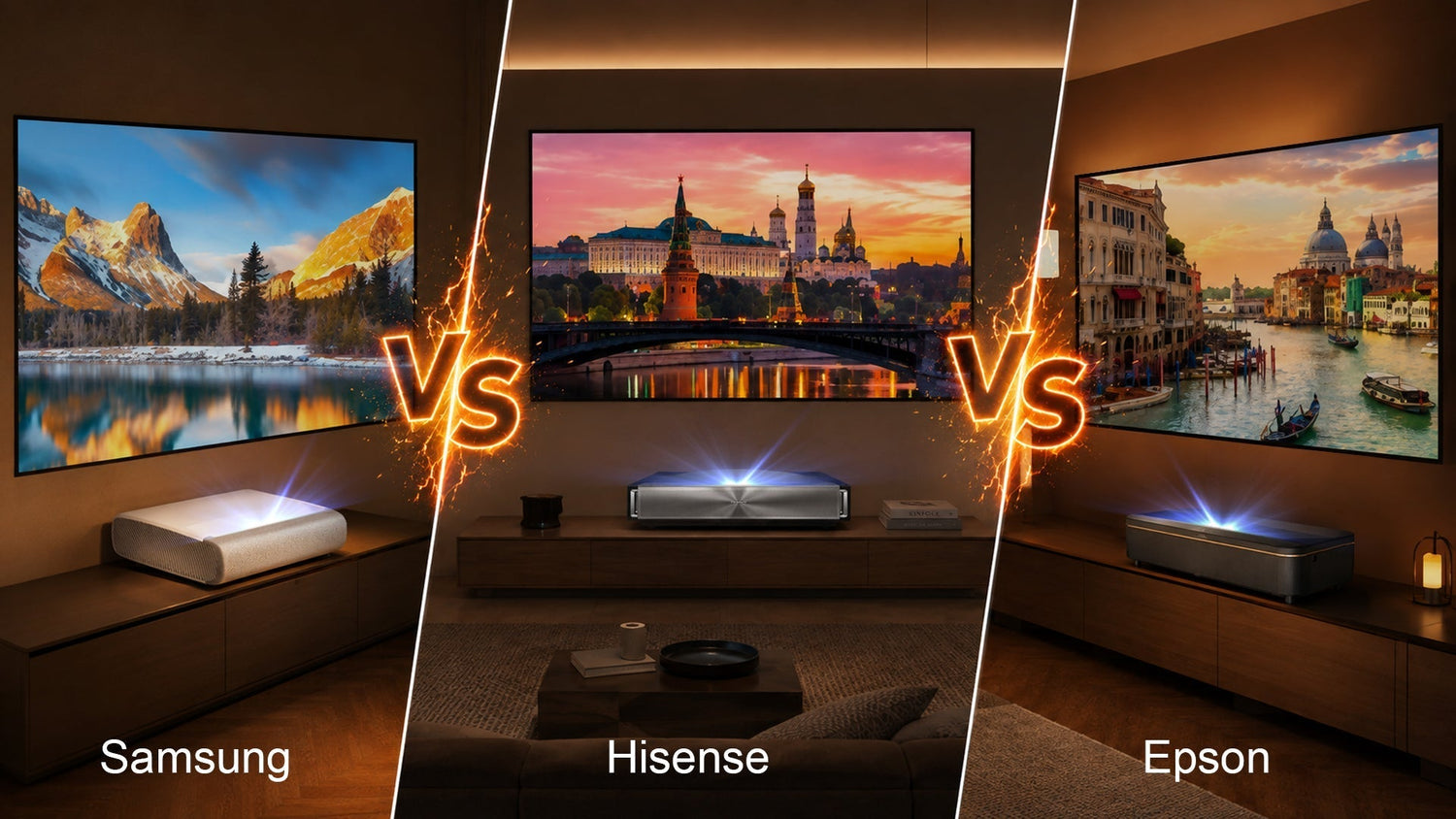
Flagship Showdown: Hisense L9Q vs. Samsung The Premiere LPU9D vs. Epson QS100

| Technical Feature | Hisense L9Q | Samsung LPU9D | Epson QS100 |
|---|---|---|---|
| Brightness | 5,000 ANSI Lumens | 3,450 ISO Lumens | 4,500 ISO Lumens |
| Display Engine | RGB Triple-Laser DLP | Triple-Laser DLP | 3LCD with Pixel Shifting |
| Contrast Ratio | 5,000:1 Native Contrast | Standard Dynamic | 2,500,000:1 Dynamic |
| Color Gamut | 110% BT.2020 Coverage | 154% DCI-P3 | 100% sRGB / DCI-P3 tier |
| Max Screen Support | 100 – 150 Inches | Up to 130 Inches | Up to 150 Inches |
| Audio Architecture | 6.2.2 Channels, Dolby Atmos | 40W, 2.2.2 Channels | Integrated Stereo |
| Laser Life | 25,000 Hours | 20,000 Hours | 20,000 Hours |
| Key Highlights | Pantone Validated Color Accuracy | Smart Hub, Ultra-Short Throw (0.189) | 3LCD Technology without Color Wheel |
Head-to-Head Analysis
Brightness: The Hisense L9Q's 5,000 ANSI lumens is the clear winner. The Epson QS100's 4,500 ISO lumens is impressive, but ISO and ANSI standards differ in measurement—ANSI is typically more conservative. Samsung's 3,450 ISO lumens, while bright, falls significantly short.
Color Performance: Hisense's 110% BT.2020 coverage is industry-leading. Samsung's 154% DCI-P3 is impressive, but BT.2020 is a wider color space—Hisense's achievement here is more significant for futureproof HDR content.
Value Proposition: The Samsung LPU9D is priced at a premium that reviewers have noted is more than twice as high as alternatives to Hisense. Hisense delivers comparable or superior specifications at a fraction of the cost.
The Verdict: For sheer brightness, color accuracy, and value, the Hisense L9Q stands alone in the premium UST laser TV category. The Epson QS100 remains a strong competitor, but Hisense's triple-laser technology and BT.2020 coverage give it the edge for serious home theater enthusiasts.
Why Every UST Laser TV Needs an ALR Screen
The Physics of Projection
Here's a fundamental truth that many first-time laser TV buyers overlook: An ultra-short-throw projector is only as good as the screen it's projecting onto.
Standard white projection screens or bare walls reflect light in all directions. This causes ambient light from windows and lamps to mix with the image, causing contrast to plummet, blacks to become washed-out grays, and colors to look lifeless and foggy.

What is an ALR Screen?
ALR (Ambient Light Rejecting) screens are engineered with a special optical microstructure that rejects light coming from all directions except the projector itself.
For UST projectors specifically (which sit just inches from the screen and project upward), ALR screens use a sawtooth optical structure and light-rejecting filters. This design rejects ceiling light and overhead ambient light while reflecting projector light directly toward the viewer's eyes, rejecting up to 95% of ambient light in premium models.
The result? Vibrant, high-contrast images even in rooms with moderate ambient light. An ALR screen transforms a good laser TV into a great one—and a great laser TV into a cinematic masterpiece.
Why UST Projectors Specifically Need ALR Screens
Unlike long-throw projectors, UST projectors sit very close to the screen, project light at a steep upward angle, and are particularly sensitive to ceiling light and overhead ambient light.
Without an ALR screen, even the brightest laser TV (like Hisense's 5,000-lumen L9Q) will look washed out in a typical living room with windows or ceiling lights. With an ALR screen, the same projector delivers stunning image quality that rivals—and in some ways surpasses—traditional OLED and QLED TVs.
📊 The Viewing Experience: ALR vs. No ALR
| Viewing Condition | Without ALR Screen | With ALR Screen |
|---|---|---|
| Daytime viewing | Washed out, low contrast | Clear, vibrant, watchable |
| Nighttime with lights on | Foggy appearance, glare | Rich colors, deep blacks |
| Nighttime with lights off | Decent, but room must be pitch black | Cinema-grade, breathtaking |
| Color saturation | Reduced by ambient light | Fully preserved |
| Black levels | Grayish and muddy | Deep, inky blacks |
The Perfect Partner: NothingProjector Black Series 95% ALR Motorized Floor Rising Screen
Now that we've established why an ALR screen is non-negotiable for any serious laser TV setup, let's talk about the best value option on the market: the NothingProjector Black Series 95% ALR Motorized Floor Rising Screen.
Designed specifically for ultra-short-throw projectors, the Black Series screen delivers up to 95% ambient light rejection across a versatile 84-inch to 130-inch diagonal range, ensuring that no matter which size fits your space, your Hisense laser TV performs at its absolute best.
What Makes It Special?
- Superior 95% ALR Technology: At the heart of the Black Series is a precision-engineered optical surface that actively rejects ambient light from ceiling fixtures, windows, and other room light sources while preserving and reflecting the projector's light directly toward the viewer. This 95% ambient light rejection rate is among the highest in its class.
- Ultra-Short-Throw Optimized: Purpose-built for UST projectors, its optical microstructure is tuned to the steep upward projection angle of UST lasers, capturing and reflecting light with maximum efficiency while rejecting off-angle ambient light.
- 4K Ultra HD Ready: The premium screen surface delivers stunning 4K UHD resolution with exceptional clarity, ensuring every pixel from your Hisense laser TV is rendered with precision.
- Motorized Floor-Rising Design: The screen rises automatically from a sleek, low-profile floor-standing base with the touch of a button. No wall mounting is required, it disappears when not in use, and offers effortless operation.
- Versatile Size Range: Available in sizes from 84 inches to 130 inches diagonally, accommodating everything from compact living rooms to dedicated home theaters.
- Superior Build Quality: Features a durable, scratch-resistant surface that maintains its optical properties over years of use, with a quiet, smooth motorized mechanism and a stable base platform.

Unbeatable Value
Compared to premium ALR screens from established brands, the NothingProjector Black Series offers comparable or superior performance at a significantly more accessible price point. You're not sacrificing quality for affordability—you're getting flagship-grade ALR technology without the flagship price tag.
📊 Why This Screen is the Ideal Match for Hisense L9Q
| Hisense L9Q Feature | Why NothingProjector Black Series is the Perfect Partner |
|---|---|
| 5,000 ANSI lumens brightness | High-brightness projector + 95% ALR = daylight-viewable cinema |
| 110% BT.2020 color gamut | Precision optical surface preserves every shade and hue |
| 4K UHD resolution | 4K-ready screen material resolves every pixel with clarity |
| 100–150 inch screen support | Available up to 130 inches – ideal match for most L9Q setups |
| Premium home theater positioning | Motorized floor-rising design adds wow factor to any setup |
The Verdict on NothingProjector Black Series
The NothingProjector Black Series 95% ALR Motorized Floor Rising Screen delivers cinema-grade image quality at a price that makes it accessible to serious home theater enthusiasts. When paired with a Hisense laser TV—especially the flagship L9Q—it unlocks the full potential of the display, delivering vibrant colors in daylight, deep immersive blacks, crisp 4K detail, and modern convenience.
If you're investing in a premium laser TV like the Hisense L9Q, skimping on the screen is like buying a sports car and putting budget tires on it. The NothingProjector Black Series ensures you get every dollar's worth of performance from your investment.
Conclusion: Hisense is the Laser TV Leader – and the Right Screen Makes It Unbeatable
The data is unequivocal:
- 70.3% global market share
- Seven consecutive years at #1
- 2,675 patents and counting
- Standard-setting authority
- Industry-first innovations from 2014 to today
Hisense has earned its title as the global leader in laser TV through a combination of market dominance, technological innovation, patent protection, and standard-setting influence that no competitor can match.
But leadership isn't just about the numbers—it's about the real-world experience. And the real-world experience of a Hisense laser TV reaches its absolute peak when paired with a high-quality ALR screen like the NothingProjector Black Series 95% ALR Motorized Floor Rising Screen.
The combination delivers daylight-viewable brightness, cinema-grade color accuracy, eye-protecting diffuse reflection, and modern aesthetics. Hisense is the undisputed leader in laser TV. And with the right ALR screen, it's the best home cinema investment you can make.