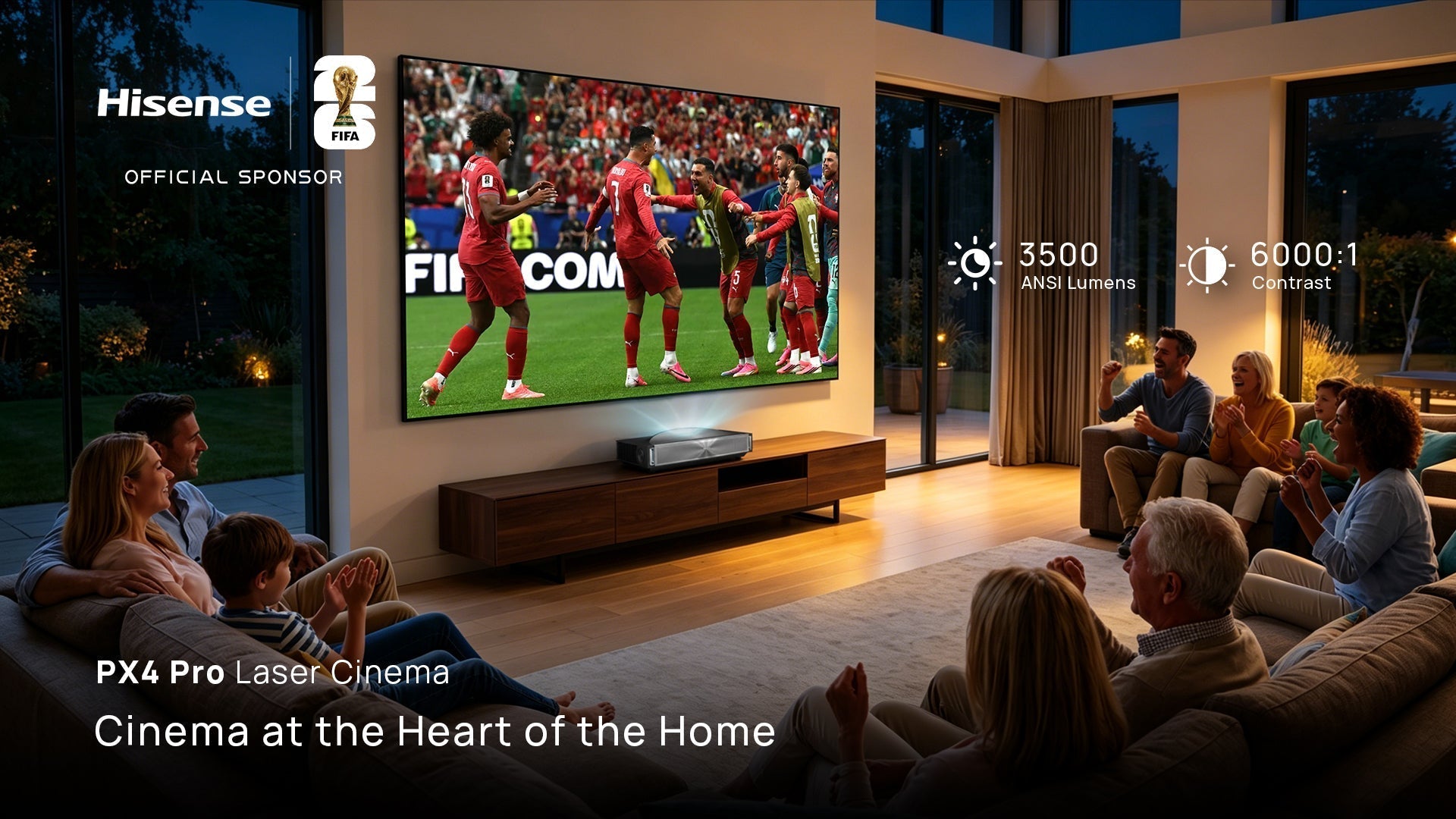




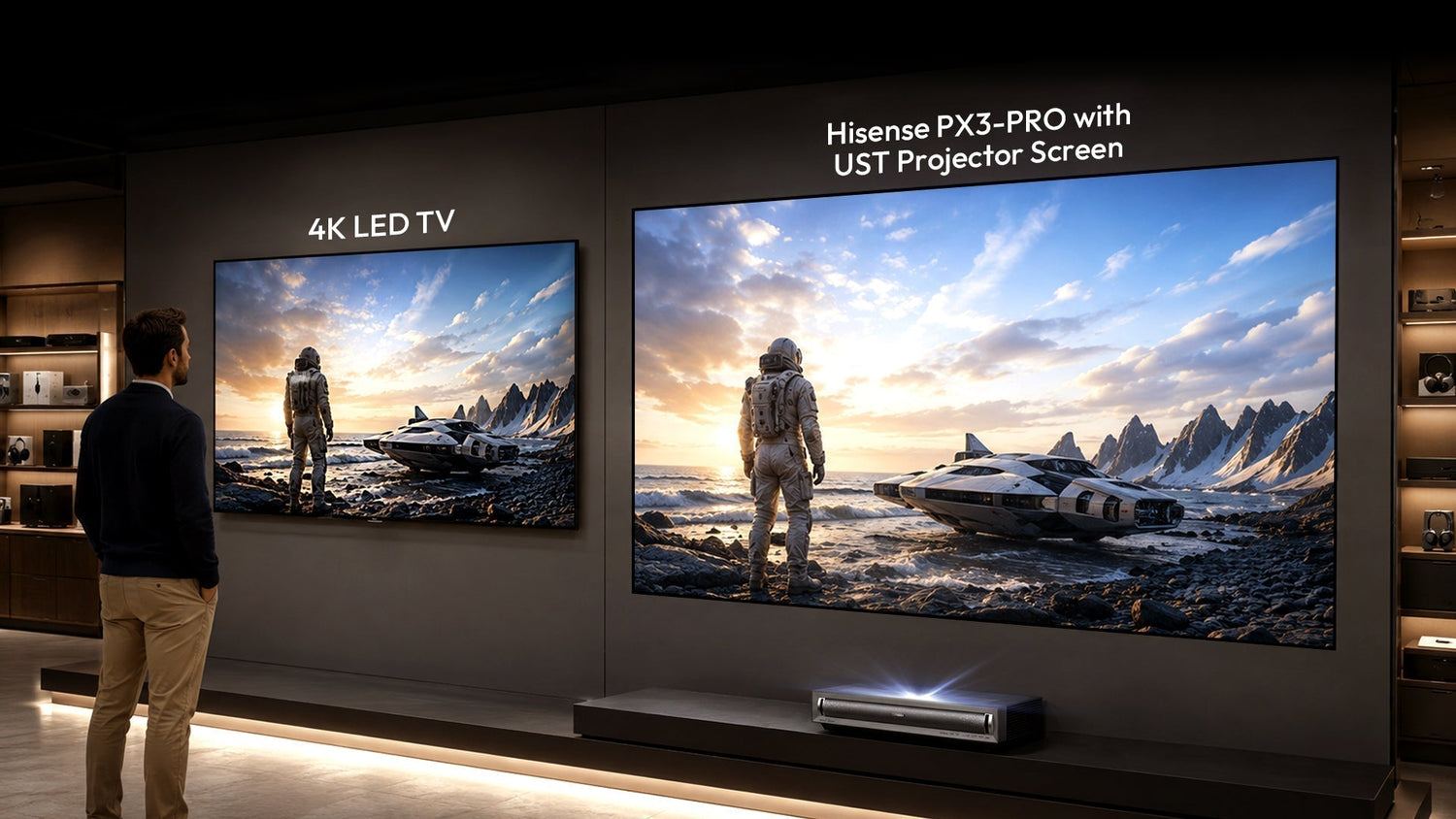
Walk into any electronics store today, and you'll face a question that would have seemed absurd just a generation ago: should you buy a television, or should you buy a projector for your living room?
For decades, the answer was obvious. The television was the undisputed centerpiece of the home. But the rise of affordable, high-quality projectors has turned that certainty upside down. Yet a persistent myth lingers—that projectors offer nothing more than a larger screen.
Is that really all there is to it?
Let's trace the fifty-year evolution of both technologies, dig into who's actually buying what, and settle the debate once and for all.
Part One: A Tale of Two Screens — 50 Years of Evolution
The Television: From Luxury to Living Room Staple
In 1970, the television achieved what few consumer electronics ever do: near-universal adoption. By that year, 95% of American households owned at least one television set, with the average American watching 5.9 hours per day. The TV had transformed from a postwar novelty into the gravitational center of family life. The 1970s and 1980s cemented this status. Cable television penetration grew from under 20% of households in 1976 to nearly 70% by 1996. The television wasn't just an appliance—it was the hearth around which families gathered. Iconic sets like the JVC Videosphere (1970) became cultural artifacts, while shows like The Waltons and The Cosby Show reflected the TV's central role in American homes.
The 1990s brought the next revolution: rear-projection televisions that could exceed 40 inches for the first time. By the late 1990s, DVD-Video format and Dolby Digital 5.1 surround sound began transforming home entertainment. High-definition televisions (HDTVs) arrived in the early 2000s, and the plasma and LCD eras followed.

The Projector: From Boardroom to Bedroom
Projectors had a very different origin story. Throughout the 1980s and early 1990s, they were strictly professional tools—overhead projectors for classrooms, bulky LCD projectors for business presentations. By 1990, there were 18 LCD projector manufacturers marketing products that averaged 18 pounds, delivered 300-400 ANSI lumens, and were louder than the average HVAC system.
The home cinema projector was born in the late 1990s. But these early models were expensive, cumbersome, and required dedicated dark rooms. They were the domain of wealthy enthusiasts, not average consumers.
Sony's first LCD projector for domestic consumer use marked a turning point, and the company's 'QUALIA 004' SXRD HD Projector became the world's first Full HD-compatible projector for home use. Yet even then, projectors remained a niche product.
The 2020s: Convergence
Today, the lines have blurred. Home cinema projectors saw 14% growth in the first half of 2025 alone, and when combined with TVs over 70 inches, they now command a 12% global market share. The question is no longer whether to consider a projector—it's which one is right for you.
Part Two: Who's Watching What — A Demographic Deep Dive
Television Viewers: Age is the Great Divider
The television audience has never been more polarized by age.
In the UK, 84% of all video viewing time still happens through a television—it remains the primary content consumption device in British homes. But how people watch tells a very different story.
Younger viewers (16–24) spend an average of 3 hours 19 minutes daily watching video content, with about two-thirds coming from streaming platforms like Netflix and YouTube. Traditional broadcast content accounts for less than a quarter of their viewing. When a 16- to 24-year-old sits down to watch something, only 19% of their in-home viewing time goes to broadcaster content.
Older viewers (75+) present a mirror image. They watch 6 hours 26 minutes daily—nearly double the younger demographic—and approximately 90% of that comes from traditional broadcasters. In Spain, people over 65 watch more than six and a half hours of television per day.
Gender differences persist as well. Women continue to lead television consumption, watching an average of 32 minutes more per day than men.
What are they watching?
In the US, Netflix's Stranger Things topped the 2025–2026 season with an average of 32.9 million viewers. The Australian children's cartoon Bluey was streamed for 45.2 billion minutes on Disney+, while Grey's Anatomy secured 40.9 billion minutes. In the UK, The Celebrity Traitors dominated, drawing over 15 million viewers for its finale, with Netflix's Adolescence attracting 13.2 million.
YouTube has become the second-largest "channel" in UK homes, accounting for about 14% of all viewing time—ahead of ITV (12%) and Netflix (8%), behind only BBC (19%).

Projector Owners: A Tale of Two Markets
Projector ownership demographics reveal a fascinating split based on price point.
Under $500 (Budget/Casual Segment):
This segment appeals to first-time buyers, apartment dwellers, dorm residents, and those seeking casual home cinema setups or outdoor movie experiences. Key characteristics include:
- Price sensitivity as the primary purchase driver
- Often used in bedrooms or multi-purpose spaces
- Portable form factors valued for flexibility
- Typically younger demographic (20s–30s)
$500–$3,000 (Mid-Range to Premium Segment):
This is where the home theater enthusiast lives. The global home theater projector market was valued at approximately $3.42 billion in 2024 and is projected to reach $5.89 billion by 2033. Users in this bracket prioritize:
- Image quality and contrast performance
- 4K resolution and HDR capabilities
- Dedicated home theater or media room setups
- Often paired with ALR screens for improved daytime viewing
- Typically older demographic (30s–50s) with disposable income
The global projector market itself is undergoing a bifurcation—splitting into a high-volume, commoditized segment driven by value brands, and a high-value premium segment anchored in innovation and experiential claims.
Part Three: The Ultimate Question — Is Size Really the Only Advantage?
Let's settle this once and for all.
Beyond the Big Screen: What Projectors Actually Do Better
- 1. The True Cinematic Experience: Projectors don't just create a large image—they create an immersive one. Unlike a television, which remains a defined rectangle on your wall, a projected image can become the wall itself. There's a psychological difference between watching a 75-inch TV and watching a 120-inch projected image that fills your field of vision.
- 2. Eye Comfort: Projectors are gentler on the eyes. Since they reflect light off a screen rather than emitting it directly, they reduce eye strain, especially during extended viewing sessions. This is a significant advantage for movie marathons or gaming sessions that stretch into the night.
- 3. Cost-Per-Inch Value: This is where projectors truly shine. A 100-inch television comes at a premium price that still makes many consumers wince. A projector delivering the same 100-inch image—or larger—can be had for a fraction of the cost. The value proposition is straightforward: you get more image for your money.
- 4. Portability and Flexibility: A projector can move from room to room, from apartment to apartment, from indoor movie night to backyard screening. Try doing that with a 100-inch television.
- 5. Improved Technology is Closing the Gap: Are projectors still behind OLED TVs in pure image quality? Yes, particularly in black levels and peak brightness. But the gap is narrowing. Modern projectors with ALR screens can reproduce wide color gamuts and handle HDR reasonably well. High-end models now deliver contrast and color accuracy that would have been unthinkable a decade ago.
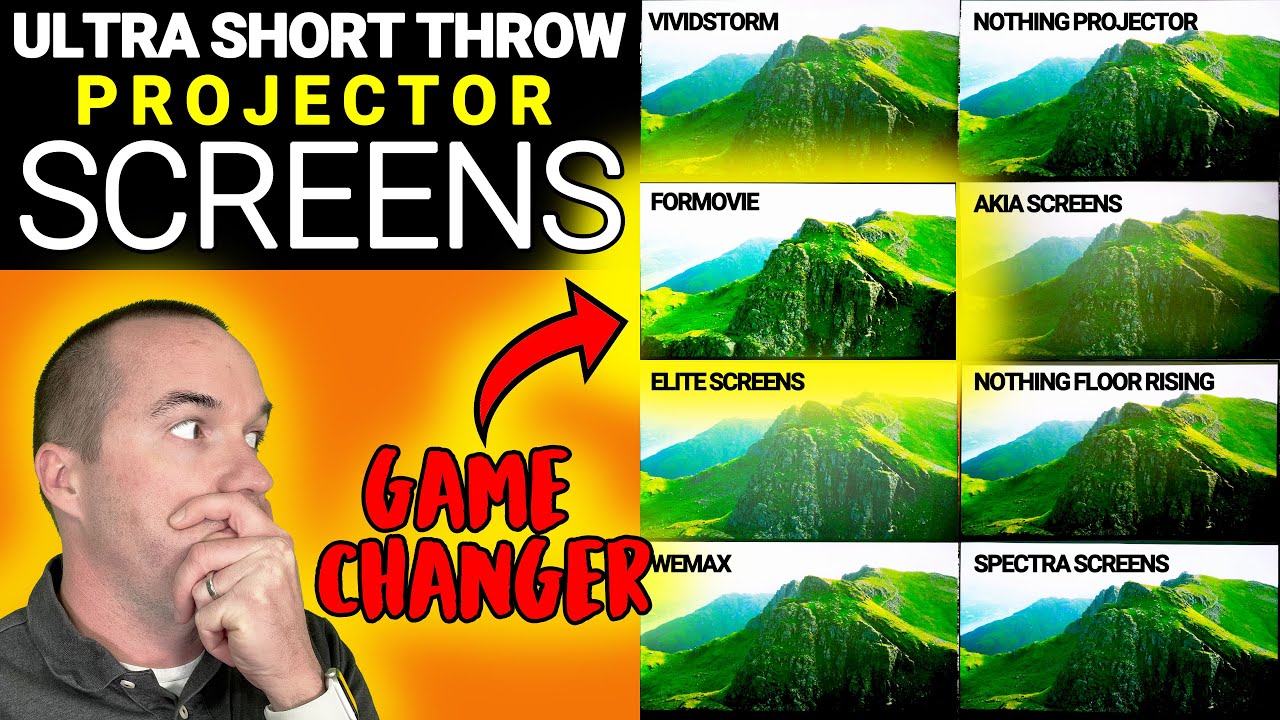
- 6. The Screen Matters as Much as the Projector: Here's a truth that many overlook: the screen is half the equation. A mid-range projector paired with a high-quality ALR screen can outperform a premium projector projecting onto a white wall. Ambient Light Rejecting screens reject up to 95% of ambient light, preserving contrast and black levels even in rooms that aren't pitch black.
Part Four: Has the Television Become Obsolete?
Absolutely not—and here's why.
Where Television Still Wins
- 1. Ambient Light Performance: A television works in any lighting condition. Whether it's bright midday sun or a fully lit room, an OLED or QLED TV delivers consistent, vibrant images. Projectors, even with ALR screens, still perform best in controlled lighting environments.
- 2. Plug-and-Play Simplicity: Televisions are effortless. Plug it in, connect to Wi-Fi, and you're watching. No screen alignment, no focus adjustments, no concern about ambient light.
- 3. Long-Term Reliability: A television has no bulbs to replace, no moving parts to wear out. Modern LED and OLED TVs can last a decade or more with minimal maintenance.
- 4. Gaming Performance: Most projectors still lack the advanced gaming features—high refresh rates, low input lag, VRR support—that are standard on mid-range and premium TVs. For competitive gamers, a TV remains the superior choice.
So Who Should Buy What?
Choose a Portable Projector (Under $500) if:
- You live in a small apartment and don't want to deal with moving a large TV
- You value flexibility and portability
- You're a first-time buyer exploring the category
- You want occasional outdoor movie nights
Choose a TV if:
- You have a bright living room with lots of windows
- You want the simplest possible setup
- Gaming performance is your top priority
- You prefer a "set it and forget it" experience
Choose a Premium Projector ($500–$3,000) with a Quality Screen if:
- You have a dedicated media room or basement
- You're a movie enthusiast who values the cinematic experience
- You want a 100-inch+ image without the five-figure price tag
- You're willing to invest in proper room lighting control
Part Five: Is a Projector Complicated to Use?
Let's address the elephant in the room.
No—a projector with a proper screen is as easy to use as a television.
The complexity myth persists from the early days of home projection, when setups required professional calibration and dedicated dark rooms. Today's projectors feature:
- Automatic keystone correction and focus
- Built-in smart TV platforms (Google TV, Android TV, etc.)
- Wireless streaming capabilities
- HDMI inputs for all your devices
The real key to simplicity? Invest in a quality screen.
A projector without a proper screen is like a sports car with budget tires—it'll work, but you're not experiencing the full potential. With an ALR screen, your projector performs well even in rooms with ambient light, eliminating the need for blackout curtains or dedicated dark spaces.

The Screen Matters: Introducing NothingProjector
This brings us to an essential recommendation. If you're investing in a projector setup, the screen is not an afterthought—it's the foundation.
NothingProjector, established in 2019, has carved a niche in the market by specializing in home projectors and Ambient Light Rejecting (ALR) screens. As authorized dealers for many brands with global retail and B2B partnerships, they've built a reputation for professional consultation and technical support.
Media reviews speak for themselves. One reviewer noted that the NothingProjector Black Series motorized screen "stands out as an innovative and aesthetic home cinema solution, capable of instantly transforming any space into a projection room". Another praised the ALR screen's "unreal viewing angles," stating they didn't think "there's a TV, monitor, smartphone, or projection screen out there that offers such extreme viewing angles".
Top NothingProjector Screens
1. NothingProjector Black Series 95% ALR/CLR Ultra Short Throw Projector Screen (84"–150")
This is the gold standard. With 95% ambient light rejection, a 170° viewing angle, and 4K UHD resolution support, it's designed specifically for ultra-short throw projectors. The ST Carbon Black coating and premium PET Crystal materials deliver exceptional contrast and deeper black levels in almost all lighting conditions. Available in sizes from 84 to 150 inches.
2. NothingProjector Black Series 95% ALR Motorized Floor Rising Screen (84"–130")
For those who want cinema magic at the push of a button, this motorized floor-rising screen transforms any room into a theater in seconds. With zero drilling or mounting required, it's perfect for renters or those who want flexibility. The precision tensioning system, normally reserved for high-end models, ensures a perfectly flat viewing surface. It also features silent, autonomous operation with voice control.
3. NothingProjector PET Crystal Classic 85% ALR UST Projector Screen (100"–150")
An excellent entry point into ALR technology, this screen delivers 85% ambient light rejection with a 160° viewing angle. It offers exceptional value for performance, with reviewers praising it as "a meaningful upgrade for a home theater setup" that pairs perfectly with the best value projectors on the market.

Final Verdict
The projector versus television debate isn't about which technology is "better"—it's about which is better for you.
Projectors offer far more than just a larger screen. They deliver a cinematic experience that televisions simply can't replicate, with better eye comfort, superior cost-per-inch value, and the flexibility to transform any space into a home theater.
But televisions remain essential for bright rooms, effortless setups, and uncompromising gaming performance.
The smartest approach? Match the technology to your lifestyle. For a dedicated media room or home theater, a premium projector paired with a quality ALR screen—like those from NothingProjector—delivers an experience that no television can touch. For the living room where the family gathers during daylight hours, a television remains the practical choice. The golden age of home entertainment isn't about choosing sides. It's about having options—and knowing which one fits your life.