



AWOL Vision’s Bold Leap: From Crowdfunding Disruptor to Premium UST Contender
AWOL Vision may be a relative newcomer to the home entertainment space, but its trajectory over the past 18 months has been nothing short of extraordinary. The company—operating on a “US brand + China design center” model—has raised nearly $30 million across two record-breaking Kickstarter campaigns, with the vast majority of its 12,000 backers hailing from North America, Europe, and Australia—the very markets Sony, JVC, and Samsung have dominated for decades. In a global projector market that contracted 4.8% in 2025, AWOL’s ultra-premium laser segment doubled in sales.
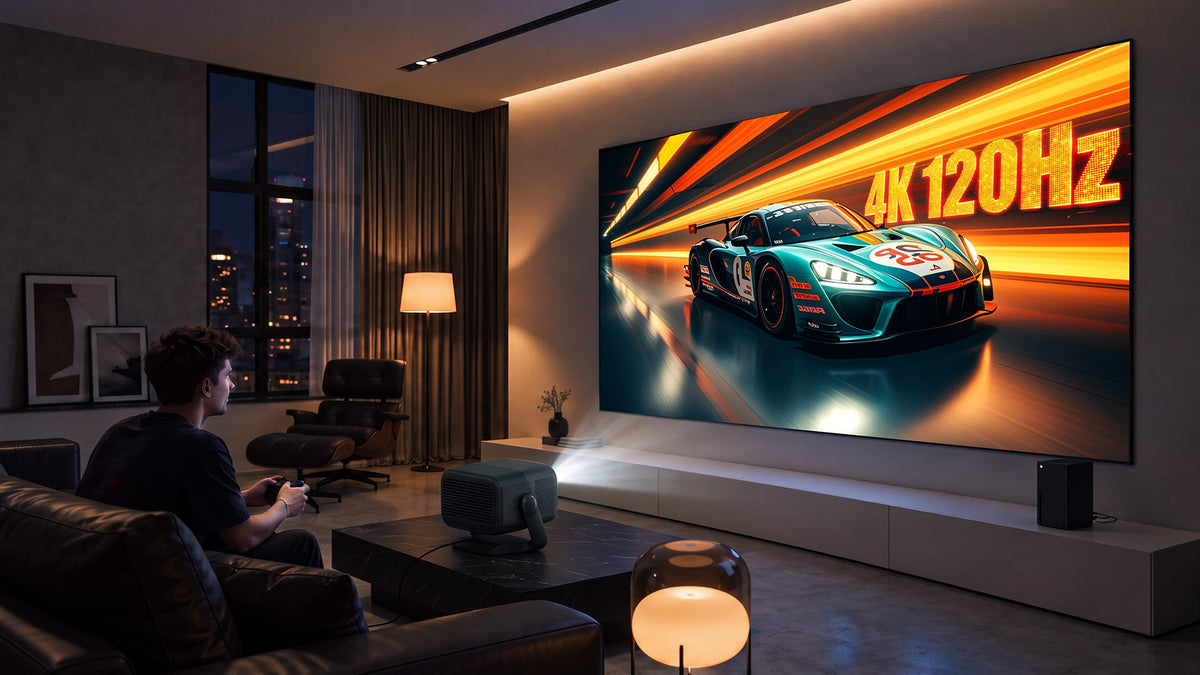
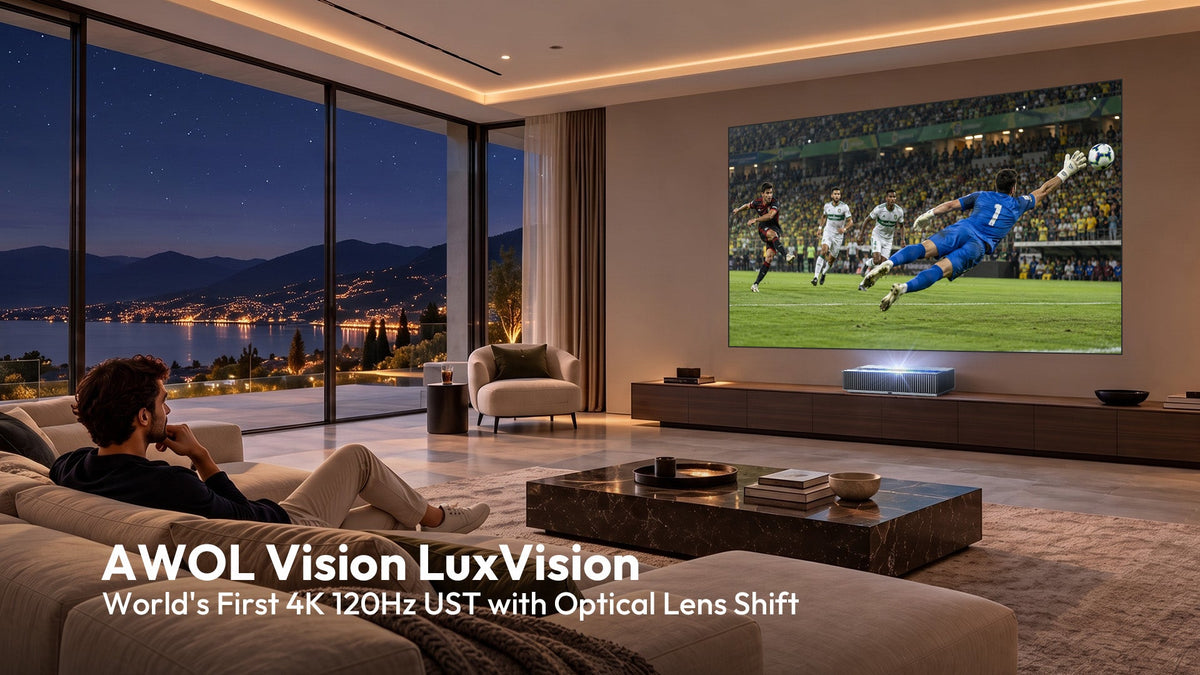
Now, at CEDIA 2026 in Denver and IFA 2026 in Berlin, AWOL Vision has unveiled its new flagship: the LuxVision, a triple-laser RGB ultra-short-throw projector that the company bills as the world’s first UST to combine native 4K at 120Hz with true optical lens shift. It launches around October 2026 at $5,999 in the US, €5,999 in Europe, and £4,999 in the UK.
What Makes LuxVision a Genuine UST Breakthrough
Optical Lens Shift: No More Digital Trickery
The headline feature is optical image shift—a capability that, until now, has been essentially nonexistent in the UST category. Most UST projectors rely on digital keystone correction to position the image, which degrades 4K detail by resampling pixels. The LuxVision moves the entire optical output up or down without touching the pixel grid, preserving full 4K sharpness corner-to-corner.
This matters more than the spec sheet suggests. As CNET noted, UST projectors are notoriously difficult to set up despite what marketing materials claim—they demand precise leveling, angling, and height adjustment, with virtually no non-mechanical ways to fine-tune the image once the projector is in place. Optical shift changes that equation entirely, giving installers and DIY enthusiasts a simple, detail-preserving adjustment mechanism.
6,000 ISO Lumens: The Brightest UST Yet
At 6,000 ISO lumens, the LuxVision doesn’t just edge past the competition—it laps it. For comparison, AWOL’s own Aetherion Max tops out at 3,300 ISO lumens, and XGIMI’s AURA 3 Max reaches 5,700. That nearly 2x brightness advantage over the Aetherion Max means the LuxVision can genuinely compete with ambient light in a living room, not just a darkened home theater.

The brightness boost comes from an RGB triple-laser light source paired with a 0.47-inch DLP473TE DMD chip and dual DLPC8555 display controllers—a hardware combination specifically designed to push nearly a billion pixels per second without the chroma artifacts that plagued earlier high-refresh 4K DLP attempts.
Performance Deep-Dive: Aetherion Max vs. LuxVision
| Specification | AWOL Aetherion Max | AWOL LuxVision |
|---|---|---|
| Light Source | RGB Triple Laser | RGB Triple Laser |
| Brightness | 3,300 ISO Lumens | 6,000 ISO Lumens |
| Resolution/Refresh | 4K (no 120Hz) | Native 4K at 120Hz |
| Optical Lens Shift | No | Yes (vertical) |
| Chipset | MediaTek MT9655 | Not yet disclosed |
| RAM/Storage | 8GB / 128GB | Not yet disclosed |
| Native Contrast | 6,000:1 (60,000:1 dynamic) | Not disclosed (7-level iris + EBL) |
| Color Gamut | 110% Rec. 2020 | 110% Rec. 2020 |
| Anti-RBE | Yes | 2nd-gen Anti-RBE |
| Input Lag | 1ms-class at 240Hz | ~1ms at 120Hz |
| Price | $4,999 | $5,999 |
The $1,000 premium buys you roughly double the brightness, 4K/120Hz support, and optical lens shift. For gamers and sports fans, the 120Hz refresh rate is transformative—4K at 120Hz means fluid motion without the judder that plagues 24fps film content on fixed-refresh displays. The LuxVision also supports Dolby Vision Gaming, VRR, ALLM, and three HDMI 2.1 ports.
Color Accuracy and Aberration Handling
AWOL Vision’s approach to chromatic aberration and pixel misalignment has evolved from the Aetherion’s PixelLock technology—which handles alignment across optical, mechanical, and digital layers—to an even more refined optical engine in the LuxVision. The projector uses a magnetron sputtering coating process applied in a vacuum environment to reduce internal reflections and improve edge-to-edge uniformity. Combined with second-generation Anti-RBE processing, the LuxVision aims to eliminate the rainbow artifacts that have historically plagued single-chip DLP projectors.

The LuxVision also inherits the Aetherion’s EBL (Enhanced Black Level) Shadow Refinement system and adds a seven-stage dynamic iris for scene-by-scene brightness optimization.
How LuxVision Stacks Up Against CEDIA 2026 and IFA 2026 UST Rivals
XGIMI AURA 3 Max: The Value Challenger
XGIMI’s AURA 3 Max arrived with its own “world’s first” claim for native 4K/120Hz UST projection, and it’s a serious machine. At 5,700 ISO lumens with an 8,000:1 native contrast ratio (via a Dynamic Dual Iris system) and an 80W Harman Kardon audio system with Dolby Atmos, the AURA 3 Max is aggressively specced. Its Kickstarter pricing of $2,199–$2,399 undercuts the LuxVision by more than half.
The trade-off: The AURA 3 Max lacks optical lens shift, meaning UST installation positioning is less forgiving. Its throw ratio of 0.163:1 is slightly shorter than the LuxVision’s 0.18:1, which can be advantageous in tight spaces but amplifies hotspot risk on Fresnel screens at very large sizes.
JMGO IRIS Ultra Max: The Portable Option
JMGO’s entry claims a different kind of first—native 4K/120Hz in an all-in-one movable projector rather than a fixed UST installation. At 6,500 ISO lumens with a 360°/150° AI-powered gimbal, it targets users who want to move their projector between rooms. Early-bird pricing starts at $2,999.
The trade-off: Its portability comes at the cost of the dedicated UST install experience. For a permanent living-room setup with an ALR screen, the fixed-install LuxVision or AURA 3 Max makes more sense.
| Projector | Type | Brightness | 4K @ 120Hz | Native Contrast | Optical lens shift | Price |
|---|---|---|---|---|---|---|
| AWOL Vision LuxVision | Fixed UST, RGB triple laser | 6,000 ISO lumens | Yes (native) | Not disclosed (7-level iris + EBL) | Yes (vertical) | $5,999 |
| AWOL Aetherion Max | Fixed UST, RGB triple laser | 3,300 ISO lumens | No | 6,000:1 (60,000:1 dynamic) | No | $4,999 |
| XGIMI AURA 3 Max | Fixed UST, triple laser | 5,700 ISO lumens | Yes | 8,000:1 (Dynamic Dual Iris) | No | $2,199-$2,399 (Kickstarter) |
| JMGO IRIS Ultra Max | All-in-one movable, triple laser | 6,500 ISO lumens | Yes | Not specified | Not specified (360 deg / 150 deg AI gimbal) | $2,999 (early bird) |
The Verdict by Use Case
- Bright living room, maximum flexibility: LuxVision wins on raw brightness and optical shift.
- Budget-conscious 4K/120Hz gaming: AURA 3 Max delivers ~90% of the experience at ~40% of the price.
- Multi-room portability: JMGO IRIS Ultra Max is in a class of its own.
The Business Case: Why AWOL Vision Is Playing the Long Game
AWOL Vision’s product cadence tells a story of deliberate market positioning. The Aetherion series (launched via Kickstarter in early 2026) established the brand’s technical credibility at the $3,500–$5,000 price point. The LuxVision, arriving barely six months later, pushes into $6,000 territory—directly challenging established players like Hisense and Formovie at their own game.
The strategic logic is clear:
- Price anchoring: By launching Aetherion at $4,999 and LuxVision at $5,999, AWOL creates a perception of premium positioning that makes the Aetherion look like the “value” option.
- Feature leadership: Optical lens shift is a genuine differentiator that no direct competitor currently matches. It’s not a spec-sheet gimmick—it addresses a real pain point in UST installation.
- Ecosystem lock-in: By offering custom CMF (color, material, finish) options for the first time, AWOL is nudging LuxVision buyers toward treating the projector as furniture, not just a device—which encourages longer ownership cycles and future accessory purchases.
The risk is clear: at $5,999, the LuxVision competes with 100-inch+ Micro LED and Mini LED TVs that don’t require a darkened room or an ALR screen. AWOL bets that the 200-inch ceiling and the flexibility of projection still carry weight for a meaningful segment of premium buyers. Given that the company has already proven it can move 12,000 units at $3,000+ price points through crowdfunding alone, that bet looks reasonable.

Why an ALR Screen Is Non-Negotiable for UST Projectors
If you’re spending $5,999 on a LuxVision, projecting onto a white wall is like buying a sports car and driving it on bald tires. Here’s the physics: UST projectors fire light at an extremely steep angle (the LuxVision achieves a 120-inch image from just 7.5 inches away). On a standard matte white screen, that steep light bounces off the screen and scatters toward the ceiling and walls, washing out contrast and creating a “ceiling glow” effect. An ALR (Ambient Light Rejecting) screen with a CLR (Ceiling Light Rejecting) surface is engineered to reflect the steep-angle light from the projector back toward the viewer while absorbing light from above and the sides.
As veteran AVS Forum reviewer Erik Wesley put it: “Marry your screen and date your projector.” The screen is the long-term investment—technology in this category doesn’t change dramatically every couple of years, and once it’s installed, replacing it is far more disruptive than upgrading a projector.
NothingProjector Black Series: The Screen That Matches the Projector
NothingProjector’s Black Series ALR screens have earned a reputation in enthusiast circles for delivering flagship-level performance without the flagship price tag. The fixed frame version uses a 0.6-gain ALR/CLR surface with an ST Carbon Black coating, supports 4K and 8K, and features micro-perforations for acoustically transparent speaker placement behind the screen. The motorized floor rising version adds the convenience of a retractable screen that disappears into a 16.5cm-deep floor housing when not in use, preserving the room’s aesthetics for non-movie time.

| Black Series version | Surface | Gain | Resolution | Acoustically transparent | Fits into the room |
|---|---|---|---|---|---|
| Fixed frame | ALR/CLR with ST Carbon Black coating | 0.6 | 4K and 8K | Yes (micro-perforations) | Permanent wall installation |
| Motorized floor rising | ALR/CLR with ST Carbon Black coating | 0.6 | 4K and 8K | Yes (micro-perforations) | Retracts into a 16.5cm-deep floor housing |
The AVS Forum verdict: In a dedicated review, the NothingProjector 120-inch Black Series Motorized Floor Rising Screen earned an AVSForum Top Choice for 2025 designation. Reviewer Erik Wesley praised its “spectacular specular highlights with deep blacks,” “low laser speckle,” and “minimal rainbow effect,” ultimately concluding it was so good he kept both the screen and the Hisense PX3 projector he had bought to test it. Another AVS Forum thread from a user running an AWOL Aetherion Max directly praised the combination: “We are using an AWOL Vision Aetherion Max rated at 3500 lumens, placed just over 22” in front of a 120“ Nothing Projector Black 95% ALR/CLR screen. We are satisfied that it does a very nice job of counteracting the ambient daylight in our living room”.
What The Hookup says: The Hookup’s YouTube channel has become the de facto reference for UST screen comparisons. In his screen shootout videos, he has consistently highlighted the importance of matching screen surface technology to projector throw characteristics—specifically warning against using long-throw ALR surfaces with UST projectors, which causes shimmer, sparkle, and poor uniformity. While The Hookup’s final recommendations have leaned toward low-gain Fresnel surfaces for maximum brightness, the community consensus—echoed across AVS Forum threads—is that NothingProjector’s Black Series represents the best value in the ALR/CLR category. For LuxVision buyers specifically, the combination of a 6,000-lumen projector and a 0.6-gain ALR screen creates a balanced system: the projector has enough brightness headroom to drive the lower-gain surface to reference-level image quality, while the ALR surface preserves black levels and contrast in a living room with ambient light.
Final Thoughts
The AWOL Vision LuxVision is not just a spec upgrade—it’s a statement of intent. With 6,000 ISO lumens, native 4K/120Hz, and the first optical lens shift system in a UST projector, it addresses the two biggest compromises of the category: brightness limitations and installation inflexibility. The $5,999 price is steep, but for buyers who want a genuine 200-inch cinema experience that works in a real living room with lights on, it’s a compelling proposition.
Pair it with a NothingProjector Black Series screen—fixed frame for maximum image quality, motorized floor rising for maximum lifestyle flexibility—and you have a system that can genuinely replace a large-format TV while offering something no flat panel can: a 120-inch image from 7.5 inches away, with the lights on and the game on.