


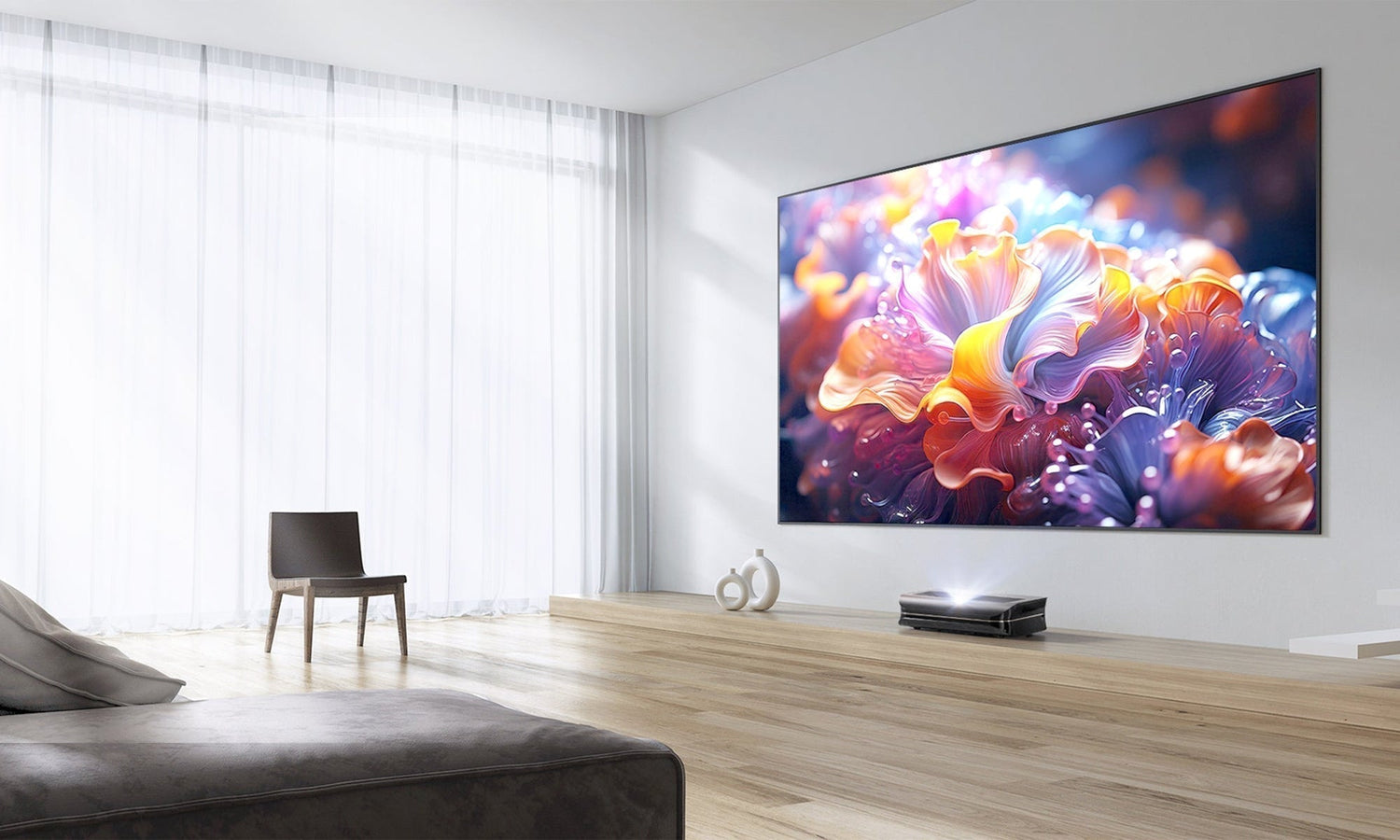
If you’ve invested in a quality projector, you might believe stunning visuals depend solely on the projector itself. While a great projector is crucial, it’s only half of the equation. To truly unlock its potential and achieve a cinematic experience, a dedicated projection screen is not just an accessory—it’s a necessity. This is especially true in rooms with ambient light. An Ambient Light Rejecting (ALR) screen is the key component that can transform your viewing experience from "good enough" to absolutely breathtaking.
1. The Unmatched Advantages of an ALR Screen
A dedicated projector screen, especially an ALR model, does far more than just provide a white surface. It employs specialized optical coatings and materials engineered to work in harmony with your projector's light.
- Superior Contrast & Black Levels: This is the most significant upgrade. In a non-controlled environment, ambient light washes out the image, making blacks appear gray. An ALR screen's core function is to reject light coming from the sides (like windows or lamps) while preserving the light coming from the projector. This results in dramatically deeper blacks, higher contrast, and an image that feels vibrant and punchy even with the lights on.
Enhanced Color Accuracy & Saturation: The specialized surface of an ALR screen is designed to reflect the projector's light spectrum more effectively. This means colors appear more true-to-life, richer, and saturated. You’ll see the intended color palette without the dullness caused by ambient light interference.

- Effective Brightness Management: An ALR screen optimizes the available light from your projector. By directing more useful light back to the audience and rejecting ambient light, it effectively makes the image appear brighter and more vivid without requiring you to max out your projector's brightness setting, which can often reduce lamp life and compromise contrast.
- Sharper Image with Reduced Hot-Spotting: High-quality ALR screens have a uniform surface that disperses light evenly. This minimizes "hot-spotting" (a bright center spot) and ensures edge-to-edge sharpness, revealing more detail in both dark shadows and bright highlights.
2. How Does an ALR Screen Work? The Science of Selective Reflection
The magic of an ALR screen lies in its directional light control. Think of it like a one-way street for light.
- Standard white screens are diffuse, scattering light in all directions. This makes them sensitive to all light sources in the room, degrading the image.
-
ALR screens are directional. Their surface is typically composed of micro-layers, optical lenses, or dark substrates that absorb or deflect light hitting the screen from angles outside the projector's specific location. Simultaneously, they efficiently reflect light coming from the projector's precise angle straight back to the viewing area.
Key factors in this system include:

- Projector Placement & Screen Type: The screen's technology is tuned for a specific projection angle. This is why UST (Ultra-Short-Throw) ALR screens and Long/Standard Throw ALR screens are fundamentally different and not interchangeable.
- Viewing Cone: ALR screens have an optimal "viewing cone" where the image looks brightest and most contrast-rich. Sitting within this cone is crucial for the best experience.
- Screen Size & Gain: The size must match your room's scale and projector's output. "Gain" refers to a screen's reflectivity compared to a standard white surface. ALR screens often have a lower, more controlled gain (e.g., 0.5 - 1.0) that prioritizes contrast and wide viewing consistency over raw brightness.
3. UST vs. Standard Throw Projectors: They Require Different ALR Screens
This is a critical point of confusion. You cannot use a standard ALR screen with a UST projector, and vice versa.
-
For UST Projectors: The projector sits just inches below the screen, firing light upward at a very steep angle. A UST ALR screen is engineered with a layered optical filter. It accepts this steep-angled light and reflects it downward to the viewer, while rejecting ambient light coming from the ceiling or opposite directions. Using a standard throw ALR screen with a UST projector would result in a extremely dim or invisible image.

-
For Long/Standard Throw Projectors: These projectors are mounted on the ceiling or far behind the audience, sending light straight onto the screen. A standard throw ALR screen is designed to accept this frontal light and reflect it directly back, while rejecting light coming from the sides (windows). Its microstructure is completely different from a UST screen.

4. How to Choose the Right ALR Screen for Your Setup
Selecting the perfect large projector screen involves matching the screen type to your room's aesthetics, layout, and your usage habits. Here’s a breakdown of common formats, inspired by comprehensive selections like those found at NothingProjector:
| Screen Type | Core Features & Advantages | Ideal For |
| Fixed Frame Screen | A rigid, permanently taut screen mounted in a frame. Offers the flattest, most uniform surface for impeccable image quality. No wobble or waves. Professional, cinematic look. | Dedicated home theaters or media rooms where the screen can remain in place. The best choice for ultimate picture performance. |
| Motorized Projector Screen | A retractable screen that rolls down from a hidden ceiling or wall recess at the touch of a button. Saves space and maintains room décor when not in use. | Living rooms, multi-purpose rooms, or spaces where you want the home theater to be hidden when not in active use. |
| Dropdown Screen (Manual) | Similar to motorized but manually pulled down. A more economical, simple solution for occasional use. Often lightweight and portable. | Budget-conscious setups, secondary rooms, or temporary installations where convenience is key. |
Your Selection Checklist:
1. First, Match Throw Type: Confirm the ALR screen is explicitly designed for your UST projector or long/standard throw projector.
2. Choose Your Format: Decide between the permanent elegance of a Fixed Frame, the convenience of a Motorized projector screen, or the simplicity of a manual dropdown.
3. Measure Meticulously: Ensure your chosen screen size (diagonal) fits your wall and provides a comfortable viewing distance (typically 1.5 to 2.5 times the screen height for optimal immersion). 4. Consider the Room: Evaluate your primary ambient light sources. Side windows? A standard throw ALR is ideal. Overhead lights? A UST ALR screen handles that well.
Conclusion: The Essential Final Touch
An ALR screen is not merely a purchase; it's an investment in the full potential of your home theater. It is the defining element that battles ambient light to deliver contrast, color, and clarity that a plain wall or a standard screen simply cannot match. By understanding its advantages, how it works, and carefully selecting the right type for your projector and room, you unlock the most stunning visual performance your projector is capable of delivering. Transform your viewing experience from ordinary to extraordinary with the precise technology of an ALR screen.