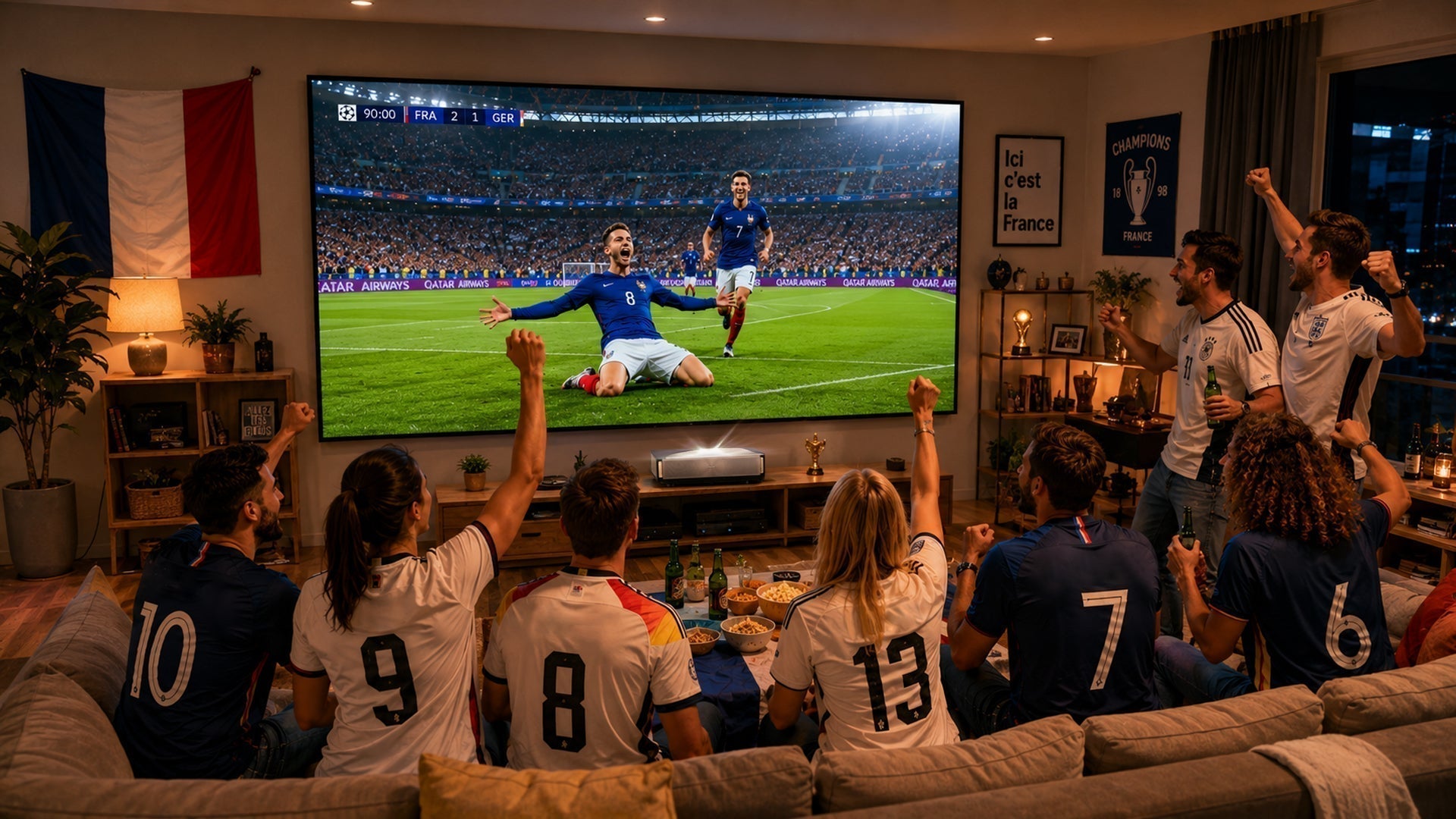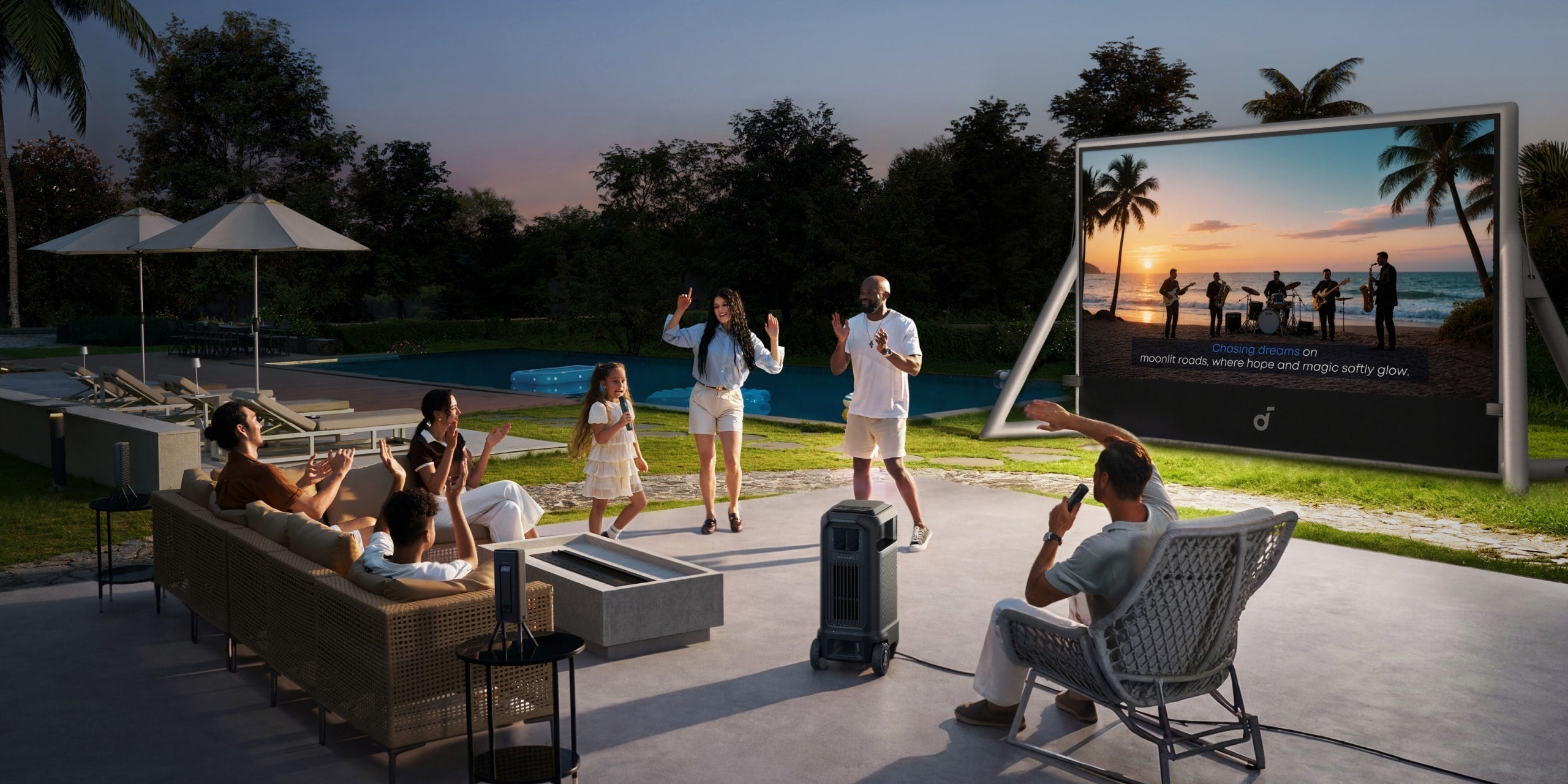



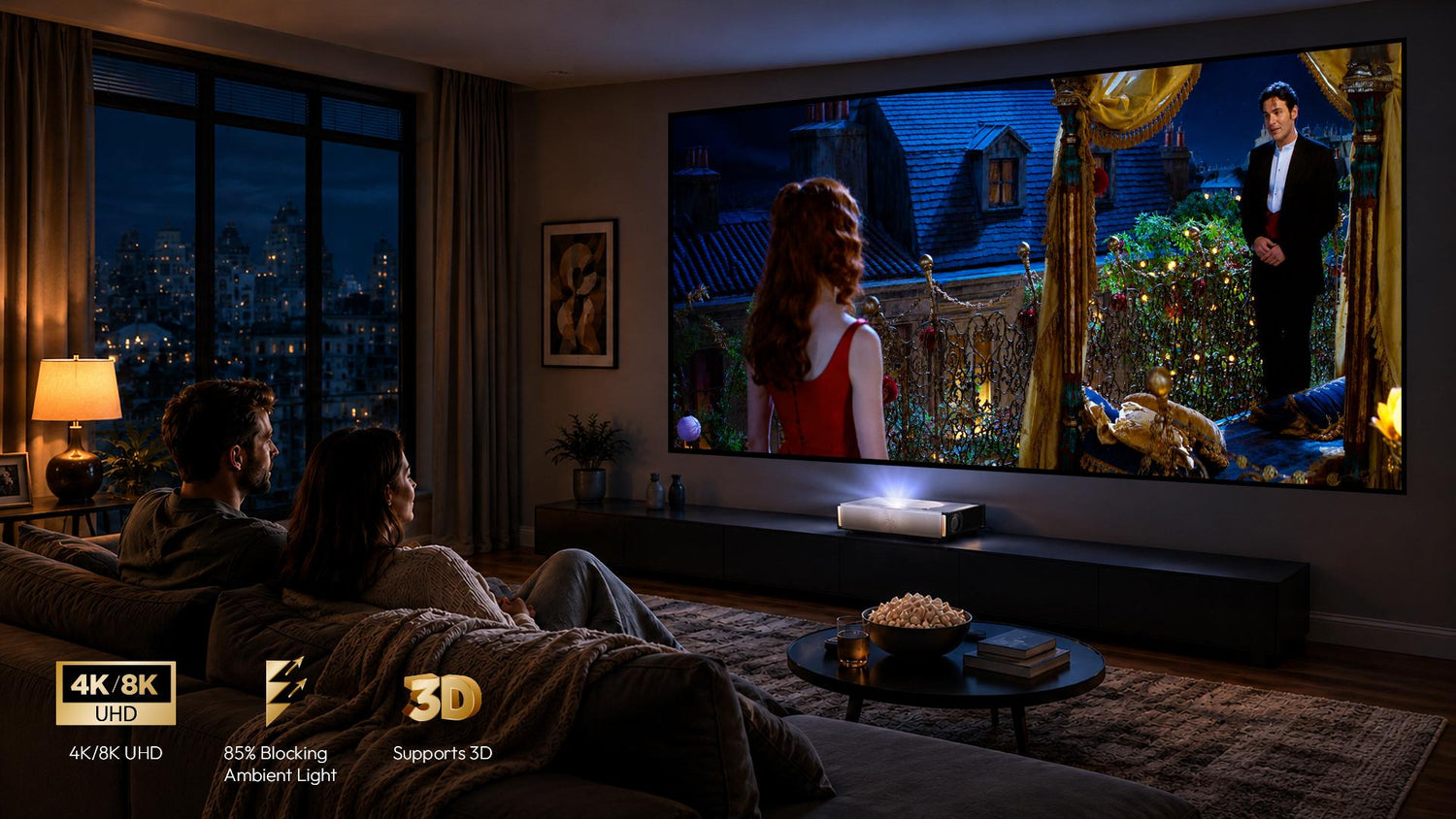
You've just invested in an ultra-short-throw projector—perhaps a Hisense, AWOL Vision, or XGIMI. You pull back the curtains, hit play… and the picture looks washed out. Grey blacks. Weak contrast. Colours that seem to have lost their punch.
The culprit isn't your projector. It's your wall.
Countless home-theatre enthusiasts fall into the same trap, projecting onto a white wall and wondering why the image falls short of what they'd hoped for. The truth is that a plain wall—no matter how smooth and freshly painted—can never match the performance of a purpose-built projection screen. And when it comes to ultra-short-throw projectors, that performance gap becomes impossible to ignore.

In this guide, we'll walk through the science of why walls fail, hear what the experts have to say, and show you exactly which specifications matter when choosing a screen. We'll then put the NothingProjector Classic Fixed Frame UST Screen under the microscope, compare it against premium competitors, and explain why it stands as the best-value UST projector screen for European buyers under €400.
Why Your Eyes Deserve a Real Screen – The Science of Projection
Before we talk about products, let's talk about how human vision works—and why white walls are a problem. When you look at a projected image, what you're really seeing is reflected light. Your projector beams light onto a surface; that surface reflects some of that light toward your eyes. But the process is far from perfect.
The Problem with Diffuse Reflection
Think of light like ripples in a pond. When light strikes an ordinary wall, it scatters in every possible direction—scientists call this diffuse reflection. For your projector, that's disastrous. Instead of directing the projected image toward your eyes, a significant portion of the light bounces up toward the ceiling, down toward the floor, and sideways into the room.
Normal screens scatter light in all directions, which means a large part of the projected light is reflected onto ceilings and walls instead of returning directly to the viewer. The result? Lower perceived brightness, reduced contrast, and an image that looks "thin" and lacking in depth.

Ambient Light Is the Real Villain
The second problem is ambient light—sunlight streaming through windows, overhead ceiling lights, lamps from across the room. Any unwanted ambient light falling on a projection surface will degrade contrast and colour saturation.
A white wall is essentially helpless against ambient light. When daylight hits a wall, the wall reflects a mix of projected light and ambient light back toward you. The dark parts of the image—the shadows, the night scenes—get flooded with stray light, turning what should be deep black into a muddy grey. For a room that cannot be darkened, an Ambient Light Rejecting (ALR) screen preserves readable contrast in daylight, whereas a white wall or matte white screen simply fades away.
The Human Factor: Contrast Is Everything
From a physiological standpoint, the human eye's ability to discern detail depends overwhelmingly on contrast. The darker the blacks and the brighter the whites—the wider the gap between them—the richer and more immersive the image becomes. This is why ALR technology exists: to give viewers brightness and picture quality that rivals or even surpasses what other display technologies can provide with the lights on or off.
A white wall may work passably in a perfectly darkened, dedicated home theatre. But for 99% of living rooms, where life happens and lights turn on, a white wall simply cannot deliver the contrast your eyes crave and your projector is capable of producing.
What the Experts Say – ALR Screens Aren't Optional, They're Essential
You don't have to take our word for it. Home-theatre experts and industry veterans have been making the same case for years.
ProjectorCentral's Position
Industry authority ProjectorCentral has long emphasised that UST projectors require specialised screens. The reason why conventional white screens or even a normal wall are unsuitable for this type of projection is the reflection behaviour of the screen itself. UST projectors sit directly below the screen and fire light upward at a steep angle. A standard wall—which scatters light equally in all directions—wastes the majority of that carefully engineered light.
AVS Forum Community Insights
On AVS Forum, home to some of the world's most dedicated projection enthusiasts, the consensus is clear. Users report that a white wall causes light to bounce up to the ceiling, creating a "washout" effect that ruins black levels. An ALR screen effectively bounces the light to the viewing area and stops much of the washout from light reflecting off the ceiling—even in an otherwise dark room.
Independent reviewers have also taken notice. One AVS Forum member who purchased the NothingProjector fixed-frame screen noted that multiple people mentioned how seamless and ripple-free it was, with no complaints so far. Another user praised the screen's picture clarity, especially the black levels, which are much better than the no-name brands used before.
GeekStreet on UST ALR Screens
YouTube reviewer GeekStreet has also weighed in on the topic, noting that UST ALR screens are designed with a special optical structure that reflects light from a very low angle (as from UST projectors placed below the screen) while rejecting ambient light from above.
The Verdict from Simple Home Cinema
After setting up a NothingProjector Black Series fixed-frame screen, one reviewer came away impressed: "It's easy to assemble, feels well-built, and delivers deep contrast and clean images even in tricky lighting. When paired with the right UST projector, it punches far above its price tag."
And in a separate review, the same source noted that the NothingProjector Black Series delivers impressive performance for its price, with excellent build quality, strong ambient-light rejection, and a clean, high-contrast image when properly paired with the right UST projector.
The message from experts across the board is unanimous: if you own a UST projector and want the image quality you paid for, an ALR screen is not a luxury—it's a necessity.
How to Choose the Right UST Screen – The Specifications That Actually Matter
Now that you understand why you need a screen, let's look at how to choose the right one. Not all screens are created equal, and understanding a few key specifications will help you make an informed decision.
- 1. ALR (Ambient Light Rejection) Technology: A specially engineered surface that reflects light from your projector toward the viewing area while rejecting ambient light coming from other directions. ALR screens use directional surface technology with microscopic ridges or layers to control how light is reflected. This is the single most important feature for any UST screen used in a normal living environment to prevent a washed-out display. The best screens reject 80–95% of overhead ambient light.
- 2. Gain: A measure of how much light the screen reflects compared to a standard matte white reference surface. A gain of 1.0 means it reflects as much light as the reference. For UST projectors, lower gain (typically 0.5–0.8) is actually preferable because it distributes light more evenly, enhances black levels, and prevents "hotspotting"—an overly bright spot directly above the projector. Gain varies from 0.5 to 1.3 depending on the model, with prices ranging from €500 for a basic screen to over €2,000 for high-end references.
- 3. Viewing Angle: The maximum angle (measured from straight-on) at which the screen maintains acceptable brightness and colour accuracy. In a home theatre, not everyone sits directly in front of the screen. A wide viewing angle ensures that people seated to the sides still see a vibrant, correctly coloured image. Look for screens with at least 160°.
- 4. PET Crystal Material: A multi-layer PET (polyethylene terephthalate) cloth with a directional reflective coating, featuring a precision-engineered sawtooth optical structure. PET Crystal is widely regarded as the best ALR screen material for UST projectors. Its special sawtooth structure rejects ambient light with remarkable efficiency while preserving accurate colour reproduction. With gain typically around 0.8, PET Crystal eliminates "foggy" images and delivers bright, vivid pictures even under bright light.
- 5. Build Quality and Flatness: The rigidity of the frame and the tensioning system that keeps the screen material perfectly flat. A screen that isn't perfectly flat will introduce ripples and distortions that are instantly noticeable, especially during panning shots. A well-built fixed-frame screen should feel rigid and show no visible waves or wrinkles across the entire surface.
Meet the NothingProjector Classic Fixed Frame UST Screen
Having established what to look for, let's examine the NothingProjector Classic Fixed Frame UST Screen – a product purpose-built to deliver premium performance without the premium price tag.
Advanced PET Crystal ALR Technology
At the heart of this screen lies high-quality PET Crystal material—the same technology used by far more expensive screens. The screen features an advanced ALR technology that rejects 85% of ambient light from overhead and lateral sources. Using a precisely designed sawtooth optical structure, the screen reflects your projector's light directly toward the viewing area while absorbing ceiling and side lighting. The result is vibrant images, deep contrast, and crisp detail—even in sun-filled rooms, with no blackout curtains necessary.

Optimised 0.6 Gain for Perfect Colour Fidelity
Where some screens push gain higher at the expense of colour accuracy, the NothingProjector Classic takes a more balanced approach. With a 0.6 gain, the PET Crystal surface delivers precise, vivid colour reproduction without distortion or colour shift. The 0.6 gain strikes an ideal balance between brightness and contrast, displaying every detail of 4K, 8K, and 3D content with no hotspots and no glare—just pure visual clarity. For comparison, premium brand AWOL Vision's ALR screens also target a peak gain of 0.6, confirming that this figure represents industry best practice for UST setups.

Ultra-Wide 160° Viewing Angle
No matter where you sit, you get a clear, vibrant image. The 160-degree viewing angle guarantees that everyone in the room—whether seated centre or off to the side—enjoys the same high-end cinema experience. Perfect for movie nights with family, presentations, or shared workspaces. Typical PET Crystal ALR screens in this category also offer a gain of 0.8 and a 160° viewing angle, putting the NothingProjector Classic right alongside premium offerings.

1cm Ultra-Thin Bezel – Elegant, Minimalist Design
A screen shouldn't draw attention to itself—it should disappear into the wall. With its minimalist 1cm ultra-thin bezel, the NothingProjector Classic blends seamlessly into your wall, creating a sleek, modern look that complements any living room or home-cinema space. When the projector is on, the bezel vanishes into the image, leaving nothing between you and the content.

Family-Friendly Design – Reduced Eye Strain
Unlike televisions that emit direct, harsh light, this screen uses diffuse reflection to display the image. This helps reduce eye strain, making it safer and more comfortable for extended viewing sessions—an ideal choice for families, children, or anyone sensitive to brightness.
Broad Compatibility, Flat, Durable, and Easy to Install
The NothingProjector Classic is designed to pair perfectly with leading UST projector brands including Hisense, AWOL Vision, and BenQ, turning your space into a true cinematic experience without needing blackout curtains. The screen features a frosted aluminium frame that keeps the PET Crystal surface perfectly flat and tensioned, eliminating ripples and wrinkles that plague cheaper screens. The 45-day price adjustment guarantee, 30-day satisfaction warranty, and one-year hassle-free warranty provide complete peace of mind.
How It Compares – NothingProjector vs. The Premium Competition
To truly appreciate the value proposition of the NothingProjector Classic, let's compare it against three well-known alternatives available in the European market.
| Feature / Spec | NothingProjector Classic Fixed Frame | Elite Screens Aeon CLR 3 | AWOL Vision Daylight ALR | VIVIDSTORM S PRO Floor Rising |
|---|---|---|---|---|
| ALR Technology | PET Crystal ALR, 85% light rejection | CLR 3 (Ceiling Light Rejecting), 80% rejection | Daylight Fresnel ALR, 85% rejection | ALR/CLR lenticular |
| Gain | 0.6 | ~0.6 (typical for CLR material) | 0.6 | Not specified |
| Viewing Angle | 160° | Not published | 170° | Wide (proprietary) |
| Frame Type | Fixed frame, 1cm ultra-thin bezel | Fixed frame, Edge Free | Fixed frame or motorised | Motorised floor rising |
| Compatibility | Hisense, AWOL, BenQ, XGIMI | Tabletop UST projectors | UST projectors | UST projectors |
| Approximate Price | Under €400 | From €1,299 (~100–120") | €2,032–€3,499 | €1,045–€1,785 |
- Elite Screens Aeon CLR 3 (from €1,299): The Aeon series offers Edge Free frameless technology with CLR 3 projection surface, designed specifically for tabletop UST projectors to reject overhead ambient light. Some versions, like the StarBright CLR 5 material, reject up to 80% of overhead light. However, the entry-level price sits around €1,299 – more than three times the price of the NothingProjector Classic. While the Elite Screens name carries brand recognition, the performance gap is remarkably narrow given the vast price difference.
- AWOL Vision Daylight ALR Screens (€2,032–€3,499): AWOL Vision's Daylight ALR screen boasts 85% light rejection (comparable to NothingProjector's 85%) and a 170° viewing angle. It also targets a 0.6 gain, exactly matching the NothingProjector's specification. The AWOL screen is available in 100" and 120" sizes, with the 100" model priced around €2,032 and the premium 150" version reaching €3,499. The superior viewing angle (170° vs. 160°) and the Fresnel lens technology are genuine differentiators, but at a 500–800% price premium, the law of diminishing returns applies strongly here.
- VIVIDSTORM S PRO (€1,045–€1,785): VIVIDSTORM offers motorised floor-rising ALR/CLR screens for UST projectors, with app support and voice control. Their UST ALR material also rejects 85% of ambient light. However, the price range starts at €1,044.50 and rises to €1,784.50 depending on size and features. You're paying for motorisation and convenience features rather than superior optical performance.
The Verdict – Unbeatable Value Under €400
After analysing the science, listening to the experts, scrutinising the specifications, and comparing against premium alternatives, the conclusion is clear: the NothingProjector Classic Fixed Frame UST Screen offers the best value in the sub-€400 category.
Here's why:
- Performance on par with screens costing 3–5 times as much: 85% ambient light rejection (matching AWOL's flagship), 0.6 gain (industry best practice), and 160° viewing angle. Independent reviewers consistently note that NothingProjector screens punch far above their price tag.
- You're paying for optical performance, not branding: Elite Screens and AWOL Vision charge a premium for their brand names and, in some cases, premium motorisation or extra-wide viewing angles. The NothingProjector Classic focuses budget exactly where it matters most: the screen material and optical engineering. The difference between 160° and 170° of viewing angle may matter in a showroom, but in a real living room, most users will never notice.
- European-friendly pricing and support: With pricing consistently under €400 for the fixed-frame model, the NothingProjector Classic undercuts the nearest competitors by €600 or more. Add the 30-day satisfaction guarantee, 45-day price adjustment, and one-year warranty, and the risk of purchase effectively disappears.
- Real-world quality backed by genuine user feedback: NothingProjector screens have earned positive recognition in AVS Forum discussions and independent reviews. Users highlight seamless, ripple-free construction, deep black levels, and excellent build quality.
Final Recommendation
If you own a UST projector and want a screen that delivers deep blacks, vibrant colours, and effective daytime performance—without spending a small fortune—look no further. The NothingProjector Classic Fixed Frame UST Screen is the smart European buyer's choice: premium PET Crystal ALR technology at a price that makes sense.