



Introduction: When a Projector Becomes a Statement
There is a moment that every home theater enthusiast knows well—the instant when the lights dim, the first frame appears, and you realize you are no longer watching a screen. You are inside the image.
That moment has historically been reserved for commercial cinemas or custom installations costing more than a small car. But in 2026, Hisense is making a bold claim: the XR10 brings that moment home. Priced at €5,999 and marketed as the "Apex of Projectors," this 4K triple-laser flagship represents more than just another product launch. It represents a convergence of decades of manufacturing expertise, AI-driven innovation, and an uncompromising commitment to quality that has defined Hisense since 1969.
The question for serious home theater buyers is not simply whether the XR10 is a good projector. It is whether this projector stands as definitive proof that Hisense has truly mastered the art and science of industrial AI manufacturing—and whether that mastery translates into an experience worth your investment.

The XR10 at a Glance: Specifications That Command Attention
Before we dive into the technology and the legacy behind it, let us establish exactly what the XR10 brings to the table. Released in May 2026 following a debut at CES 2026, this projector is positioned squarely at the summit of the consumer home theater market.
Core Specifications
| Specification | Detail |
|---|---|
| Resolution | 4K UHD (3840 x 2160) via XPR pixel shifting |
| Brightness | 6,000 ANSI lumens |
| Light Source | Pure RGB triple laser |
| Color Gamut | 118% BT.2020 |
| Native Contrast | 6,000:1 (with IRIS engaged) |
| Dynamic Contrast | 60,000:1 (with dynamic laser dimming) |
| Throw Ratio | 0.84 - 2.0:1 |
| Optical Zoom | 2.39x |
| Lens Shift | Vertical ±130%, Horizontal ±46% |
| Lens Elements | 16–17 all-glass elements |
| Image Size | 65 – 300 inches |
| Audio | 2.1-channel (2×8W + 15W subwoofer), tuned by Devialet and Opéra de Paris |
| Cooling | Micro-channel liquid cooling system |
| Smart OS | VIDAA OS with native Netflix, Prime Video, Disney+, Apple TV |
| Connectivity | Wi-Fi 7, Bluetooth 5.4, HDMI 2.1 (×2), HDMI 2.0, USB 3.0 (×2), Gigabit Ethernet |
| HDR Support | Dolby Vision, HDR10+, HDR10, HLG, IMAX Enhanced |
| Gaming | 1ms at 1080p 240Hz |
| Weight | 10.6 kg / 23.4 lbs |
| Price | €5,999 (€6,999 RRP) |

Market Positioning
The XR10 occupies a fascinating space in the projector market. Hisense has traditionally been known for its lifestyle projectors and Laser TVs—ultra-short-throw solutions that brought big-screen entertainment to living rooms without requiring dedicated home theater spaces. The XR10 represents a deliberate shift upward: a standard-throw projector designed to compete with dedicated home theater models while retaining the smart features and ease-of-use that lifestyle users expect.
This is not a projector for casual viewing. This is a projector for those who want to fill a 300-inch screen with an image that rivals commercial cinema—and who are willing to invest accordingly.
The Technology That Sets the XR10 Apart
Brightness: The 6,000 ANSI Lumen Revolution
The headline figure—6,000 ANSI lumens—is not just a number. It is a fundamental redefinition of what a home projector can do. Most home theater projectors top out well below 4,000 lumens, making ambient light their mortal enemy. The XR10's brightness output means that daytime viewing is no longer a compromise.
In real-world testing, the XR10 delivers on this promise. The RGB triple laser light source, rated for 25,000 hours of operation, produces not just raw brightness but brightness with color integrity—a distinction that matters enormously when you are watching content that relies on subtle gradations and accurate skin tones.
The 118% BT.2020 color gamut coverage places the XR10 ahead of competitors like the XGIMI Horizon 20 Max (110% BT.2020) and the Titan Noir Max (110% BT.2020), and exceeds the popular Titan Noir Max in color volume. This is not incremental improvement—it is a meaningful leap.

Native Contrast: The IRIS Advantage
Brightness alone does not make a great image. Contrast is equally critical, and this is where the XR10's engineering sophistication becomes evident.
The projector features a seven-level adjustable IRIS (aperture) system that allows precise control over light output. With the IRIS engaged, the XR10 delivers a native contrast ratio of 6,000:1—an exceptional figure for a DLP projector at this price point. When dynamic laser dimming is engaged, dynamic contrast reaches 60,000:1.
What does this mean in practice? Deep, inky blacks that do not wash out in bright scenes. Shadow details remain visible without crushing. Highlights retain texture without blowing out. The image holds depth whether you are watching a sunlit action sequence or a shadow-heavy thriller.
The All-Glass Optical Path
The XR10's optical system comprises 16 to 17 all-glass lens elements—a design choice that minimizes chromatic aberration, reduces color fringing, and maintains sharpness from the center of the image to the edges. This is not a cost-saving measure; it is a performance-driven decision that ensures 4K resolution is fully resolved across the entire projected image.
The 0.84–2.0:1 throw ratio with 2.39x optical zoom and extensive lens shift (vertical ±130%, horizontal ±46%) provides extraordinary installation flexibility. You are not locked into a single position to hit your target screen size. Whether your room is large or small, the XR10 adapts.

Thermal Management: The Liquid Cooling Differentiator
Here is where the XR10 truly separates itself from the competition. To deliver 6,000 ANSI lumens from a relatively compact chassis, Hisense engineered a micro-channel liquid cooling system.
This is not marketing fluff. Liquid cooling allows the XR10 to maintain stable operating temperatures without the kind of fan noise that pulls you out of a quiet scene. It ensures that brightness and color accuracy do not degrade during extended viewing sessions. And it contributes to the projector's long-term reliability.
The trade-off? Some users have reported cavitation noise from the liquid cooling system—a characteristic hum that may be noticeable in very quiet environments. But for most users, the thermal performance far outweighs this minor quirk.
Laser Speckle Reduction
One of the persistent challenges with RGB laser projectors is laser speckle—a grainy, shimmering effect caused by interference patterns in the laser light. The XR10 addresses this with a speckle reduction rate of just 6%, significantly improving visual comfort compared to earlier laser projectors.
Smart Features and AI Integration
The XR10 is not just a passive display device. It is an intelligent home theater hub.
The Auto Magic AI Adjusting 3.0 system, powered by a QuadCam system and dual ToF (Time-of-Flight) sensors, automatically handles keystone correction, focus, screen alignment, and image optimization. The projector supports up to 15 degrees of side projection without quality loss, making installation genuinely plug-and-play.
The VIDAA OS provides native access to Netflix, Amazon Prime Video, Disney+, and Apple TV, with AirPlay 2 and Miracast for screen mirroring. Connectivity includes Wi-Fi 7, Bluetooth 5.4, and full HDMI 2.1 support with ALLM.

The Hisense Legacy: 57 Years of Quality, Now Powered by AI
To understand why the XR10 matters, you must understand the company behind it.
Hisense was founded in 1969. For 57 years, the company has followed a singular philosophy: quality through relentless iteration. Regardless of market trends or competitive pressures, Hisense has never compromised on its commitment to craftsmanship.
This commitment is not just historical—it is current and future-focused. In June 2026, at the Summer Davos Forum in Dalian, the World Economic Forum awarded Hisense the "AI Application Star" (MINDS) honor—widely regarded as the "Oscar" of AI applications. Hisense's Huangdao Factory in the Air Conditioning Division received this recognition for its "AI-Empowered Full-Process Air Conditioning Production Upgrade" case.


This award demonstrates that Hisense is not merely using AI as a marketing buzzword. The company is embedding AI deeply into its manufacturing processes, achieving measurable improvements in quality, efficiency, and innovation. This is the same rigorous, data-driven approach that informs the design and production of the XR10.
Hisense's global standing is further validated by its position as the world's #1 brand in 100-inch+ TVs (Omdia data, 2023–2025), its role as an official FIFA World Cup 2026 sponsor, and its 58 CES Innovation Awards. The XR10 itself was named a CES 2026 Innovation Award Honoree.
This is not a company that stumbled into premium manufacturing. This is a company that built its reputation on quality and is now scaling that quality with AI—and the XR10 is the most visible consumer manifestation of that capability.
Competitive Comparison: Where Does the XR10 Stand?
| Feature | Hisense XR10 | XGIMI Horizon 20 Max | XGIMI Titan Noir Max |
|---|---|---|---|
| Brightness | 6,000 ANSI lumens | 5,700 ISO lumens | 7,000 ISO lumens |
| Color Gamut | 118% BT.2020 | 110% BT.2020 | 110% BT.2020 |
| Native Contrast | 6,000:1 | 20,000:1 | 10,000:1 |
| Lens | 16–17 all-glass elements | Not specified | Not specified |
| Cooling | Liquid cooling | Standard | Standard |
| Audio | Devialet + Opéra de Paris (31W) | Harman/Kardon (24W) | Not specified |
| Smart OS | VIDAA OS | Google TV | Google TV |
| Price | €5,999 | $2,399 MSRP | Premium tier (higher) |
| Throw Ratio | 0.84 – 2.0:1 | 1.25 – 1.5:1 | Not specified |
Analysis: The XR10 leads in color gamut (118% vs. 110%), optical quality (all-glass lens system), and thermal management (liquid cooling). The Horizon 20 Max offers superior native contrast on paper but at a lower color volume. The Titan Noir Max claims higher peak brightness but at the cost of color accuracy.
The XR10's real advantage, however, is not in any single spec. It is in the integration of all these elements into a cohesive, reliable, and future-proof system.
The XR10 Difference: A Quick-Reference Checklist for Home Theater Enthusiasts
For those who want to quickly grasp what makes the XR10 exceptional, here is a concise checklist of competitive advantages:
- ☑ Industry-Leading Brightness: 6,000 ANSI lumens—the highest claimed brightness for a consumer home theater projector
- ☑ Superior Color Volume: 118% BT.2020 coverage—exceeds both the Horizon 20 Max and Titan Noir Max
- ☑ Liquid Cooling: Micro-channel liquid cooling system ensures stable performance during extended viewing
- ☑ All-Glass Optics: 16–17 element all-glass lens assembly minimizes chromatic aberration and maintains edge-to-edge sharpness
- ☑ Exceptional Installation Flexibility: 0.84–2.0:1 throw ratio with 2.39x zoom and extensive lens shift
- ☑ Professional-Grade Contrast: 6,000:1 native (with IRIS), 60,000:1 dynamic
- ☑ AI-Powered Setup: Auto Magic AI Adjusting 3.0 with QuadCam + dual ToF sensors for one-touch alignment
- ☑ Audiophile Sound: 2.1-channel system co-tuned by Devialet and Opéra de Paris
- ☑ Comprehensive HDR Support: Dolby Vision, HDR10+, HDR10, HLG, IMAX Enhanced
- ☑ Gaming-Ready: 1ms response at 1080p 240Hz
- ☑ Proven Manufacturing Excellence: Backed by 57 years of quality and AI innovation recognized by the World Economic Forum
The Final Piece: Pairing the XR10 with the Right Screen
No projector, regardless of its capabilities, can reach its full potential without a quality screen. The XR10 is no exception.
For the XR10—a standard-throw projector with a 0.84–2.0:1 throw ratio—the choice of screen matters enormously. The wrong screen will wash out contrast, introduce hotspots, or fail to handle the projector's immense brightness.
NothingProjector offers two exceptional options that complement the XR10's capabilities:
Option 1: NothingProjector Lenticular 4K ALR Projector Screen (Long/Standard Throw)
- Designed for: Long-throw and standard-throw projectors
- Technology: Lenticular ALR (Ambient Light Rejecting) with 95% ambient light rejection
- Viewing Angle: 170 degrees—ideal for wide seating arrangements
- Resolution Support: 3D, 4K, and 8K
- Gain: 0.8
This screen is purpose-built for projectors like the XR10. The lenticular structure rejects ambient light from above while maintaining a wide viewing angle, ensuring that the XR10's 6,000-lumen brightness is not wasted. Home theater forums have noted that NothingProjector screens exhibit less laser speckle than competing options—a meaningful advantage when paired with an RGB laser projector.

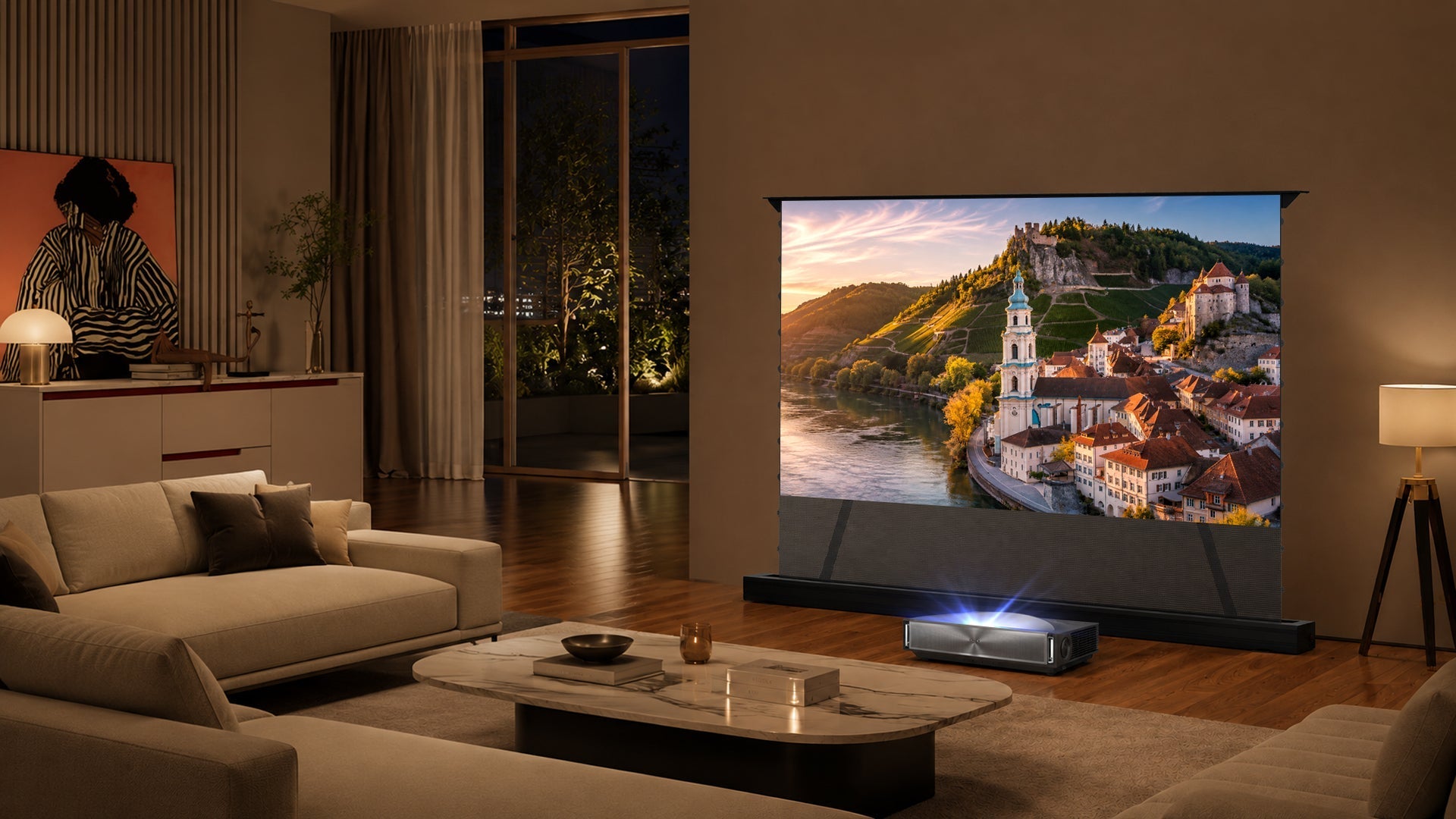
Option 2: NothingProjector Matte White Motorized Floor Rising Screen
- Designed for: Long-throw, short-throw, and UST projectors
- Technology: Matte white surface for excellent color neutrality
- Motorized: Floor-rising operation with electric retraction
- Available Sizes: 100-inch and 120-inch
- Price: €799 (100″) / €999 (120″)
This option prioritizes versatility and aesthetics. The motorized floor-rising design means the screen disappears when not in use—perfect for multi-purpose living spaces. The matte white surface ensures neutral color reproduction, allowing the XR10's 118% BT.2020 color gamut to shine without color cast interference.
Which Screen Should You Choose?
- Choose the Lenticular ALR screen if your viewing environment has significant ambient light (windows, ceiling lights) and you want maximum contrast and black levels.
- Choose the Matte White Motorized screen if you need a retractable solution, prioritize installation flexibility, or prefer a neutral surface that lets the projector's native color accuracy do the work.

Both screens are available through NothingProjector's official website.
Conclusion: The Verdict on Hisense's Industrial AI Mastery
Does the Hisense XR10 prove that Hisense has mastered industrial AI manufacturing? The evidence is compelling.
The XR10 is not a product that could have been built five years ago. The liquid cooling system required advances in thermal engineering. The 118% BT.2020 color gamut demanded precision in laser diode manufacturing. The Auto Magic AI Adjusting 3.0 system relies on sophisticated AI algorithms that Hisense has been developing for years. The all-glass optical path reflects a commitment to optical excellence that only comes from deep manufacturing expertise.
And behind all of this is a company that has spent 57 years refining its approach to quality—a company now recognized by the World Economic Forum for its AI-driven manufacturing innovation.
The XR10 is not perfect. It is expensive. It requires careful setup. The liquid cooling system produces a faint hum in some units. And its performance in very bright rooms, while improved, still benefits from some light control.
But for those who want the best possible home theater experience—who want to fill a 300-inch screen with an image that rivals commercial cinema, who want color accuracy that exceeds most consumer displays, who want a projector that adapts to their space rather than forcing their space to adapt to it—the XR10 is currently the projector to beat.
Hisense has taken its 57 years of manufacturing expertise, infused it with AI-driven precision, and created something that genuinely redefines what a home projector can be. The XR10 is not just a flagship product. It is proof that industrial AI manufacturing, when executed with discipline and vision, can produce consumer technology that feels like magic.
Your home theater deserves the best. The XR10 makes a compelling case that it has arrived.