


The Opening Whistle: Hisense’s Moment on the World Stage
The World Cup has kicked off, and once again, the world’s most-watched sporting event has put Hisense in the global spotlight. For those who have been paying attention, this is no surprise. Hisense has evolved from a Chinese domestic powerhouse into a legitimate global electronics titan—and its recent track record proves the ascent is far from over.
In the global TV market, Hisense currently sits firmly as China’s number-one television brand and the world’s number-two player, with 2025 data showing it seized 30.2 percent of global TV shipments alongside TCL in Q4 2025, exceeding the combined share of Samsung and LG at 26.2 percent. In China’s offline market, Hisense ranked first in sales revenue during the first half of 2025, with TCL and Samsung trailing behind. Most remarkably, Hisense has dominated the 100-inch-and-above TV segment for three consecutive years (2023–2025), holding a staggering 57.1 percent global shipment share in 2025. In the laser TV category, Hisense commanded an even more dominant 70.3 percent global share for the full year 2025, maintaining its number-one position. Meanwhile, foreign brands like Sony, Samsung, and Philips have seen their combined market share in China shrink to under 5 percent as of Q3 2025, reflecting a sustained decline in their domestic presence.
A Brief History of Hisense’s Projector Ambitions
Hisense’s projector journey began long before it became a household name overseas. The company debuted its first laser projector in 2014, effectively pioneering what would later be called the Laser Home Cinema category. In 2019, it introduced TriChroma triple-laser technology, a breakthrough that dramatically expanded color range and fidelity for laser projection. Since then, Hisense has steadily expanded its projector lineup to cover a widening range of use cases—from entry-level home cinema models to high-end ultra-short-throw (UST) flagships.
The predecessor, the Hisense PX3-PRO, was no slouch. At the 2024 Prestigious Projector Showdown—a globally recognized event evaluating UST projectors—the PX3-PRO captured the top spot, recognized for its exceptional color accuracy, native contrast, and sharpness. Armed with 3,000 ANSI lumens of brightness, a 3,000:1 native contrast ratio, and TriChroma triple-laser color technology, the PX3-PRO cemented Hisense’s reputation as a serious force in the UST market. It also helped Hisense maintain its laser TV global leadership—by Omdia’s data, Hisense held 65.8 percent of the global laser TV market in 2024, meaning that nearly two out of every three laser TVs sold worldwide carried the Hisense badge. Now, the baton has been passed to the next generation: the Hisense PX4-PRO.

Inside the PX4-PRO: A Technical Deep Dive
So what makes the PX4-PRO a true next-generation UST projector? The upgrades run deep, touching nearly every critical performance dimension.
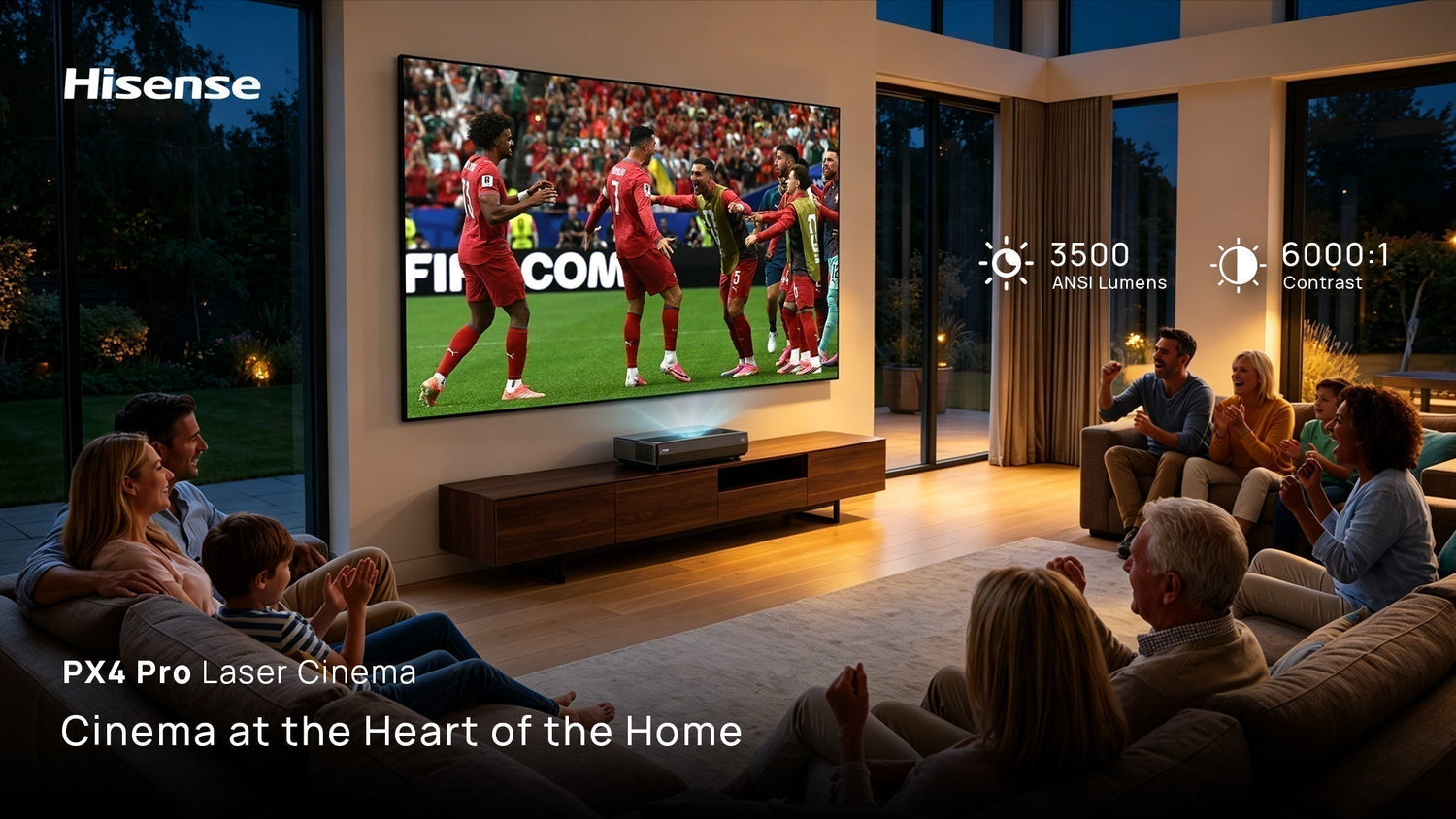
- Brightness & Projection Capacity: The PX4-PRO delivers a claimed peak brightness of 3,500 ANSI lumens—a solid 500-lumen increase over the PX3-PRO, which topped out at 3,000 ANSI lumens. This boost may not sound dramatic on paper, but in practice, it means better performance in rooms where ambient lighting isn’t perfectly controlled. The projector supports projection sizes up to 200 inches, giving you the option to transform an entire wall into a cinematic canvas.
- Contrast & IRIS Lens System: Perhaps the most significant leap comes in contrast performance. The PX4-PRO features a native contrast ratio of 6,000:1, double the 3,000:1 rating of its predecessor. This improvement is made possible by a new IRIS lens system, which adjusts the lens aperture and exposure in real time based on ambient lighting conditions to maximize contrast and preserve shadow detail. The result is noticeably better depth separation between foreground subjects and background environments—exactly what serious home theater enthusiasts crave.
- Color Technology & Imaging Engine: At the heart of the PX4-PRO sits Hisense’s signature TriChroma triple-laser light engine, which achieves full BT.2020 color space coverage for extraordinarily rich and accurate color reproduction. The projector also features a 16-element all-glass lens system and a new LPU 3.0 Digital Laser Engine, working in concert to deliver razor-sharp 4K resolution even at the largest projection sizes. A microchannel liquid cooling system helps maintain consistent performance during extended viewing sessions.
- Gaming & Response Time: This is where the PX4-PRO truly stands apart from traditional home theater projectors. According to detailed reviews, the PX4-PRO boasts a 1 ms response time for 2K at 240Hz, supports 4K at 120Hz, and includes FreeSync VRR (Variable Refresh Rate) support. That level of gaming performance was almost unheard of in UST projectors just a few years ago. For console gamers running PlayStation 5 or Xbox Series X, this means smooth, tear-free gameplay with minimal input lag—a genuine game-changer.


- Certifications & Audio: The PX4-PRO carries both IMAX Enhanced and Dolby Vision certifications, ensuring that content mastered for these high-end formats is reproduced with the intended accuracy and impact.
Industry Voices
“With a 6,000:1 contrast ratio, the PX4-PRO promises ‘vibrant colour and crystal-clear detail’ in all viewing conditions… it should still be pretty capable in brighter environments,” noted HDTVTest in their initial coverage.
Meanwhile, What Hi-Fi described the PX4-PRO as part of a “new home cinema range featuring a liquid-cooled, super bright laser projector for serious cinephiles”.
ZDNet went further, declaring that the PX4-PRO “gets so bright, it makes OLED TVs look outdated”—a bold claim that speaks to the projector’s transformative brightness in real-world viewing.
In a broader comparison, home theater analysts have noted that a “solid UST projector bundle like the Hisense PX4 PRO or an AWOL Aetherion paired with an ALR screen can give you a 100-inch big screen image” for a comparable cost to a much smaller OLED TV.
How the PX4-PRO Outpaces Its Rivals
To truly understand why the PX4-PRO deserves attention, let's see how it stacks up against today’s other leading UST projectors in the premium tier:
| Specification / Feature | Hisense PX4-PRO | AWOL Vision Aetherion | Epson QS100 4K PRO-UHD |
|---|---|---|---|
| Light Engine | TriChroma Triple-Laser RGB | Triple Laser RGB | 3LCD Laser Engine |
| Peak Brightness | 3,500 ANSI Lumens | 3,300 ISO Lumens | 4,500 Lumens |
| Native Contrast Ratio | 6,000:1 | 6,000:1 | 1,800:1 |
| Contrast Management | Active IRIS Lens System | Fixed Optical Design | Dynamic Contrast Software |
| Cooling System | Microchannel Liquid Cooling | Standard Fan Cooling | Standard Fan Cooling |
| Color Gamut Coverage | 100% BT.2020 Space | High BT.2020 Space | Limited Color Volume |
| Gaming Performance | 1ms (2K/240Hz), 4K/120Hz + VRR | 1ms (1080p/240Hz), Lacks 4K VRR | Lacks 1ms response and full VRR |
The AWOL Aetherion series has generated buzz with its gaming credentials, including VRR support, ALLM, and a claimed 1ms input latency at 1080p/240Hz powered by HDMI 2.1 connectivity. AWOL also offers 6,000:1 native contrast, 3,300 ISO lumens, and up to 200-inch projection at a starting price of roughly $3,500. Where the PX4-PRO differentiates itself is in the IRIS lens system—an active contrast-management mechanism that dynamically adapts to ambient light, something AWOL’s fixed optical design does not incorporate. Additionally, the PX4-PRO’s TriChroma engine and LPU 3.0 processing deliver a level of color accuracy and real-time image optimization that competing models have yet to fully match. Another key differentiator is the PX4-PRO’s microchannel liquid cooling system, a feature notably absent from the Aetherion’s design, enabling sustained high-lumen output without thermal throttling during extended movie marathons or gaming sessions.
Epson has countered with its QS100 4K PRO-UHD UST projector, introduced in April 2025 at $4,999. It uses a 3LCD laser engine rated at 4,500 lumens, with Epson claiming a 1,800:1 native contrast ratio that can be boosted to over 5,000,000:1 in dynamic contrast terms. While extremely bright, Epson’s offering lacks the triple-laser RGB architecture that enables the PX4-PRO’s full BT.2020 color coverage—Epson’s 3LCD approach is impressive but doesn’t hit the same saturation and color volume benchmarks. Additionally, the QS100’s gaming performance is less refined, lacking the 1ms response time and full VRR implementation found in the PX4-PRO.
From a user experience standpoint, the PX4-PRO’s TriChroma engine delivers noticeably punchier reds and deeper greens when displaying HDR content like nature documentaries or animated films. In side-by-side viewing tests, the PX4-PRO’s 6,000:1 native contrast produces superior shadow differentiation in dark scenes such as nighttime cityscapes or horror films, where competing projectors struggle with crushed blacks or lifted shadows. For gamers, the PX4-PRO’s 1ms response time and FreeSync VRR result in fluid, tear-free gameplay during fast-paced action sequences—something neither the AWOL Aetherion (despite its gaming focus) nor Epson’s models fully deliver at 4K resolution with low latency.
Where the PX4-PRO stands alone: No other projector in this class pairs a 6,000:1 native contrast via active IRIS lens adjustment with TriChroma triple-laser full BT.2020 color and sub-2ms gaming latency for 4K content. It is the rare UST projector that genuinely bridges premium home cinema and serious gaming in a single chassis.

Pairing PX4-PRO with a Quality ALR Projector Screen
All of this technical power is only half the story. To truly unlock the PX4-PRO’s potential, you need a screen that can handle its brightness, preserve its contrast, and reject ambient light—otherwise, even the best UST projector will look washed out in a typical living room. One brand quietly making waves in this space is NothingProjector. Known for offering high-performance ALR (Ambient Light Rejecting) screens at surprisingly accessible price points, NothingProjector has emerged as a compelling alternative to legacy screen manufacturers. Their screens are purpose-built for UST projectors and include three distinct models well-suited to the PX4-PRO.
For a Clean, Permanent Installation: NothingProjector Black Series Fixed Screen
Designed for those who want a dedicated, always-ready viewing wall, the NothingProjector Black Series fixed screen is a study in purposeful engineering. Its specialty lies in rejecting ambient light—up to 95 percent of ceiling and side lighting gets filtered out, letting your UST laser projector do what it does best without fighting the room’s environment. At its core is ST Carbon Black, a high-temperature-treated optical layer engineered to absorb stray light and minimize reflection. The payoff is blacker blacks, richer contrast, and an immersive depth that brings dark cinematic scenes to life. The screen also offers a 170-degree viewing angle, ensuring that whether you’re seated center or off to the side, you get a consistent, vibrant image. With 0.6 gain, sizes ranging from 84 to 150 inches, and 4K UHD support, it’s essentially a permanent canvas that turns any wall into a home theater. For PX4-PRO owners who have a dedicated media room and want zero daily friction, this is the screen that simply stays ready.

For Flexible Modern Living: PET Crystal Floor-Rising ALR Screen
Not everyone wants a permanent screen on their wall. The NothingProjector PET Crystal Floor-Rising Screen solves that with a motorized mechanism that deploys from a discreet floor base at the touch of a button—and retracts just as easily when you’re done. The name fits: its PET Crystal surface uses a black-grid physical structure that reflects 86 percent of projection light toward viewers while absorbing 85% of ambient light, delivering usable image quality in rooms with natural light or artificial illumination up to 500Lx. The screen incorporates six functional coating layers derived from Japan’s directional multi-layer coating technology, achieving 0.85 gain and a remarkable 20,000:1 ultra-high contrast ratio. The 178-degree ultra-wide viewing angle ensures that everyone in the room—whether you’re hosting a movie night or a casual family viewing—enjoys the same vivid, color-accurate image. Built with eco-friendly PVC and multi-layer protection, it’s also flame-resistant, mildew-proof, and washable, with weather tolerance from -10°C to 60°C. For PX4-PRO owners in apartments, rental homes, or simply design-conscious living rooms, this screen delivers the magic of a big screen without the commitment of a permanent fixture.

For the Ultimate Concealed Solution: Black Series Slimline Motorized Drop-Down Screen
For purists who want absolutely nothing on their walls when the projector is off, the NothingProjector Black Series Slimline Motorized Drop-Down Screen is the answer. Finished in sleek aerospace-grade aluminum, it retracts into a slim housing when not in use—disappearing from sight entirely. When you’re ready for a movie, a silent tubular motor lowers a tab-tensioned surface that remains perfectly flat, free of the ripples or waves that plague lesser drop-down screens. The lenticular ALR surface suppresses up to 95 percent of ambient light, maintaining a vivid, high-contrast image even in the brightest rooms. With a 0.6 gain and a truly impressive 180-degree viewing angle, it supports 3D, 4K, and even 8K visuals without hotspots or glare. Available in sizes from 84 to 120 inches, it offers 4-way installation: ceiling mount, wall mount, suspended, or concealed. The long-range RF remote operates from up to 30 meters away, so you never have to get up mid-movie.

A Final Word: Hisense’s Global Rise and the Perfect Companion
Watching Hisense evolve from a regional TV manufacturer to a global powerhouse has been remarkable. At CES 2026, the company demonstrated not just incremental updates but a genuine engineering philosophy—combining innovation with user-centered design, refining multi-primary color technology and applying AI algorithms to image correction. The PX4-PRO isn’t just an upgraded projector; it’s a statement of intent. It says Hisense is done playing catch-up. It wants to define the next generation of home entertainment.
But no projector exists in a vacuum. To see the PX4-PRO at its best, you need a screen that complements its strengths rather than compromises them. NothingProjector has carved out a niche at the intersection of performance and value, offering ALR screens that reject ambient light, preserve contrast, and handle the unique optical demands of ultra-short-throw projection. Whether you prefer the permanent readiness of a fixed wall screen, the flexible convenience of a floor-rising model, or the disappearing elegance of a motorized drop-down screen, there’s an option that fits both your space and your viewing habits. The World Cup has reminded us why big-screen entertainment matters. With the Hisense PX4-PRO and the right ALR screen, you’re not just watching the game. You’re living in it.