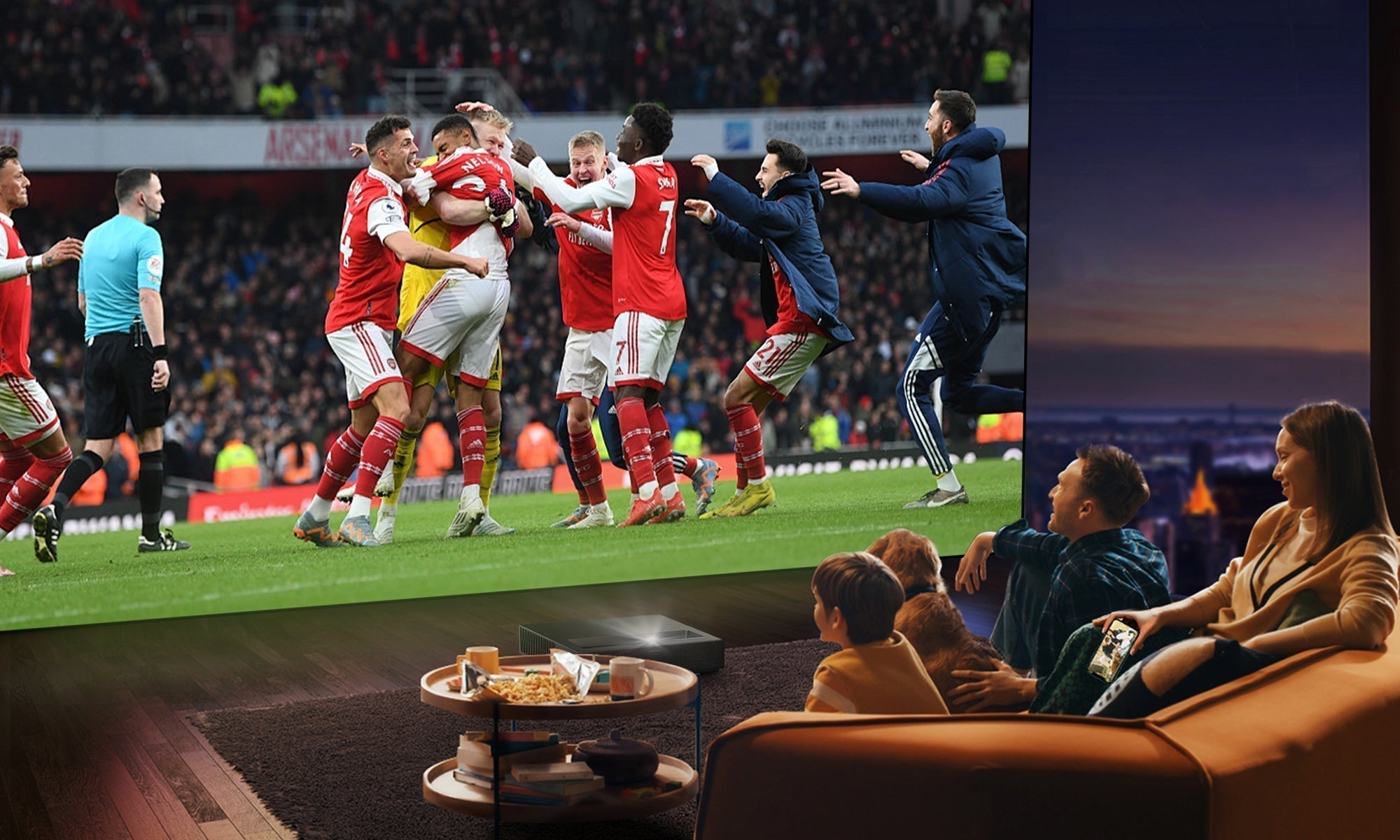



The best projectors for HDR and color accuracy in 2026 combine high-brightness laser light sources, wide color gamuts, and intelligent frame-by-frame tone mapping — so every scene looks the way the filmmaker graded it. In this guide we compare the hottest new models from Sony, JVC, Hisense, Samsung, Epson and XGIMI, explain the HDR technology that separates a good picture from a great one, and show why pairing your projector with the right screen is the single upgrade that matters most.

Best Projectors for HDR and Color Accuracy in 2026
The 2025–2026 model year has been unusually strong. Native 4K laser models have dropped in price, RGB triple-laser UST "laser TVs" now exceed 3,000 lumens, and dynamic tone mapping — once a high-end exclusive — has reached mid-range machines. Here are the standouts:
| Model | Light Source & Brightness | HDR Formats | Best For |
|---|---|---|---|
|
Sony BRAVIA Projector 8 (VPL-XW6100ES) Standard throw |
Laser · 2,700 lm | HDR10, HLG | Premium dedicated theaters |
|
JVC DLA-NZ500 Standard throw |
BLU-Escent Laser · 2,000 lm | HDR10+, HLG, Frame Adapt HDR | Movie purists under $10K |
|
Epson QL3000 / LS9000 Standard throw |
3LCD Laser · 4,000–6,000 lm | HDR10, HDR10+, HLG | Large screens & bright rooms |
|
Hisense L9Q Ultra short throw |
RGB Triple Laser · 5,000 ANSI lm | Dolby Vision, HDR10+ | TV replacement in living rooms |
|
Samsung The Premiere 9 Ultra short throw |
RGB Triple Laser · 3,450 ISO lm | HDR10+ | Smart TV-style experience |
|
XGIMI AURA 3 Max Ultra short throw |
RGB Triple Laser · 5,700 ISO lm | Dolby Vision, HDR10+, IMAX Enhanced | Bright rooms & 4K/120Hz gaming |
|
Valerion VisionMaster Pro 2 Lifestyle / long throw |
RGB Triple Laser · 3,000 ISO lm | Dolby Vision, HDR10+, IMAX Enhanced | Enthusiasts wanting flexibility |
Sony BRAVIA Projector 8 (VPL-XW6100ES)
Sony's second-from-flagship native 4K SXRD laser projector pairs the new "XR for Projectors" processor with 2,700 lumens — roughly 35% brighter than its predecessor. XR's scene-based tone mapping analyzes each frame for highlights, shadow depth and mid-tone gradation, delivering the most film-like HDR we've seen outside a grading suite. If you're building a dedicated theater around a 120–150" screen, this is the benchmark.

JVC DLA-NZ500
JVC's entry BLU-Escent laser model brings the brand's legendary native contrast — courtesy of third-generation D-ILA panels — under the $10,000 mark. Its Frame Adapt HDR system performs dynamic tone mapping scene by scene, and the new Deep Black tone control preserves shadow gradation that single-chip DLP rivals simply crush. In a light-controlled room, nothing in its class produces deeper blacks.

Epson QL3000 / LS9000
Epson's 3LCD laser lineup is the answer for big screens in rooms that aren't fully dark. Because 3LCD outputs equal color and white brightness, the quoted 4,000–6,000 lumens translate directly to saturated, punchy HDR on screens up to 200". HDR10+ support and motorized lens shift across a huge range make installation painless.

Hisense L9Q
One of the brightest consumer ultra short throw projectors you can buy: 5,000 ANSI lumens from an RGB triple-laser engine, with Dolby Vision, HDR10+, and screen sizes up to 200". Placed inches from the wall, the L9Q genuinely replaces a TV — sports at noon included. Just note that a triple-laser UST only delivers its promised contrast when paired with a proper ambient-light-rejecting screen (more on that below).

Samsung The Premiere 9
Running the same Tizen OS as Samsung's TVs, the Premiere 9 offers the slickest everyday experience in the category: native Samsung TV Plus, Gaming Hub and SmartThings built in. Its triple-laser engine covers 154% of DCI-P3 and sits just 11 cm from the wall for a 100" image. HDR10+ is on board, though Dolby Vision remains absent.

XGIMI AURA 3 Max
Launched at IFA 2026 and already one of the most talked-about USTs of the year, the AURA 3 Max pushes the category forward: 5,700 ISO lumens from an RGB triple-laser engine covering 110% of BT.2020, a dual dynamic iris delivering 8,000:1 native contrast, and the X-VISION AI processor optimizing HDR frame by frame. It's also the world's first UST with 4K/120Hz playback — with VRR, ALLM and FreeSync Premium, console gamers finally get a big-screen laser TV that keeps up. Google TV is built in, and an 80W Harman Kardon system handles the sound.

Valerion VisionMaster Pro 2
The breakout enthusiast brand of 2025–2026. The VisionMaster Pro 2 combines an RGB triple-laser engine with Dolby Vision, HDR10+, IMAX Enhanced and a rated 15,000:1 dynamic contrast, plus optical zoom that lets a single unit cover everything from a living room to a dedicated theater. It's the projector that proved "new brand" no longer means "compromise".

Understanding HDR on a Projector
HDR — High Dynamic Range — is a video signal standard that carries a far wider range of brightness and tonal information than SDR. Highlights can shine brighter, shadows keep their detail, and the image comes closer to what the human eye perceives in the real world.
Projectors face a challenge TVs don't: a projector can't hit the 1,000–10,000 nit peak brightness that HDR mastering assumes. Everything is reflected light, spread across 100 inches or more. So while a TV can simply get brighter, a projector must get smarter. That intelligence lives in two places: tone mapping and contrast enhancement.
Tone Mapping & Dynamic Contrast: What to Look For
Static vs. dynamic tone mapping
Tone mapping compresses the mastered brightness range into what your projector can actually display. Basic static tone mapping applies one fixed curve to the whole movie — fine for some titles, disastrous for very bright or very dark ones. Dynamic tone mapping (DTM) analyzes each frame or scene and adjusts the curve in real time: bright scenes keep their highlight texture instead of clipping to white, and dark scenes reveal shadow detail instead of sinking into gray mush. In 2026, look for it by name — Sony's XR processing, JVC's Frame Adapt HDR, and the DTM engines in newer mid-range models are all implementations of the same idea.

Dynamic black and laser dimming
Because a projector's contrast is limited by how little light it can emit in dark scenes, modern laser models modulate light output frame by frame. A near-black scene gets near-zero light output; a fireworks scene gets everything the engine has. The result is "dynamic contrast" figures in the tens of thousands to one — numbers that only translate to the screen when the light source responds quickly and the optical engine doesn't leak stray light.
Color Accuracy: DCI-P3, BT.2020 and Delta E
HDR is only half of a faithful picture. Color decides whether what you see matches what the colorist graded.
- DCI-P3 is the color space of theatrical masters and most HDR releases. Full coverage means the projector reproduces the colors filmmakers actually worked with.
- BT.2020 is the wider container HDR content is mastered in. RGB triple-laser projectors now reach 94–110% of BT.2020 — colors no lamp projector could ever produce.
- Delta E measures the visible gap between intended and displayed color. Below 3, errors are subtle; below 2, they're effectively invisible. Factory-calibrated models save you from buying calibration gear.
The magic happens when wide gamut and smart tone mapping work together: accurate color defines which hues you see, while tone mapping and contrast decide whether highlight and shadow detail survives the trip to your wall.

The Overlooked Half of the Equation: Your Screen
Here's the truth every reviewer eventually lands on: a projector is only half of the image. The other half is the surface it lands on. Shine a $5,000 triple-laser UST onto a plain wall and you'll watch your contrast, black levels and color saturation evaporate — walls scatter light in every direction, reflect ambient light straight back at your eyes, and show every texture imperfection at 120 inches.

A purpose-built projector screen changes the physics. Optical coatings steer the projector's light toward the audience, reject ceiling and side lighting, and give dark scenes a true black floor. It's the single upgrade that turns "a bright picture" into "a cinema".
For ultra short throw projectors
UST models need a specialized ALR/CLR surface engineered for their steep projection angle — a generic screen won't work correctly. Two approaches stand out:
NothingProjector Black Series ALR/CLR UST Screen (84"–150")
A fixed-frame screen built around an ST Carbon Black optical layer that rejects up to 95% of ambient light, with a 170° viewing angle and 8K-ready surface. It's the set-and-forget choice for a dedicated wall — and it's engineered to pair perfectly with flagship laser TVs like the Hisense L9Q/PX3-Pro, Samsung Premiere 9, XGIMI AURA 3 Max and Leica Cine 1.
See the Black Series Screen →NothingProjector Black Series Motorized Floor-Rising ALR Screen (84"–130")
Don't want a permanent frame on the wall? This motorized screen rises from its floor cabinet at the press of a button (or a voice command via Alexa/Google Assistant) and disappears when the movie ends. The same 95% ambient-light-rejecting Carbon Black surface, a perforated acoustic base border for speakers, and a tensioned PET surface that's earned Gold Awards from European home-theater press. Ideal for living rooms where the "giant TV" should vanish on demand.
See the Motorized Floor-Rising ALR Screen →
For standard, short & long throw projectors
Traditional projectors — the Sony, JVC and Epson models above — pair best with a high-gain white surface that maximizes brightness and color neutrality, especially in light-controlled rooms.
NothingProjector Matte White Motorized Floor-Rising Screen (100"–120")
A 1.3-gain matte white surface with diffuse-reflection eye protection, compatible with long throw, short throw and UST projectors alike. The motorized floor-rising design with reinforced stability structure needs no drilling or ceiling mount — roll it into place, plug it in, and let your Sony or JVC stretch its legs on a proper canvas.
See the Matte White Floor-Rising Screen →FAQ
- Is a projector worth it over a big TV in 2026?
- Above 100 inches, absolutely. TVs that size cost multiples of a good projector-and-screen combo — and a motorized screen can disappear entirely when you're not watching.
- Do I really need an ALR screen for a UST projector?
- Yes — UST projectors fire light at a steep angle, and only a UST-specific ALR/CLR surface directs it to viewers while rejecting room light. On a wall or generic screen, you lose much of the contrast you paid for.
- Can I use one screen for different projector types?
- Matte white screens like NothingProjector's floor-rising model work with long throw, short throw and UST. But ALR surfaces are angle-specific — a UST ALR screen won't work correctly with a ceiling-mounted long throw projector.
- How much brightness do I need for a living room?
- For daytime viewing with an ALR screen, 2,500+ ANSI lumens for UST or 3,000+ for standard throw. In a light-controlled theater, 1,800–2,500 lumens is plenty for 120".
- Dolby Vision or HDR10+ — does it matter?
- Both use dynamic metadata to guide tone mapping per scene. Dolby Vision has broader streaming support (Netflix, Disney+); HDR10+ is common on Samsung devices and Prime Video. With good onboard dynamic tone mapping, the practical difference is small.
Product specifications and prices are subject to change — check manufacturer sites for the latest. Some links in this guide point to NothingProjector, a specialist in ALR and motorized projection screens for UST, short throw and long throw setups.